V2 · 12 servosDated experiment
Standing, Walking, and Responding to Commands
The revised twelve-servo robot can stand, walk and respond to commands. A current build photograph, the October 6 comparison, and the latest mounting-part exports.
Published 3 min read
The robot is on its feet
The robot can now stand, walk and respond to commands. Two days ago, the printed chassis could not stand on its MG90 servos. That was the starting point for the lighter rebuild, material removal and shorter-carrier work described in the October 6 entry.
The carapace pieces are not attached yet, so the robot is still “naked.” I have not tested Active Operator.
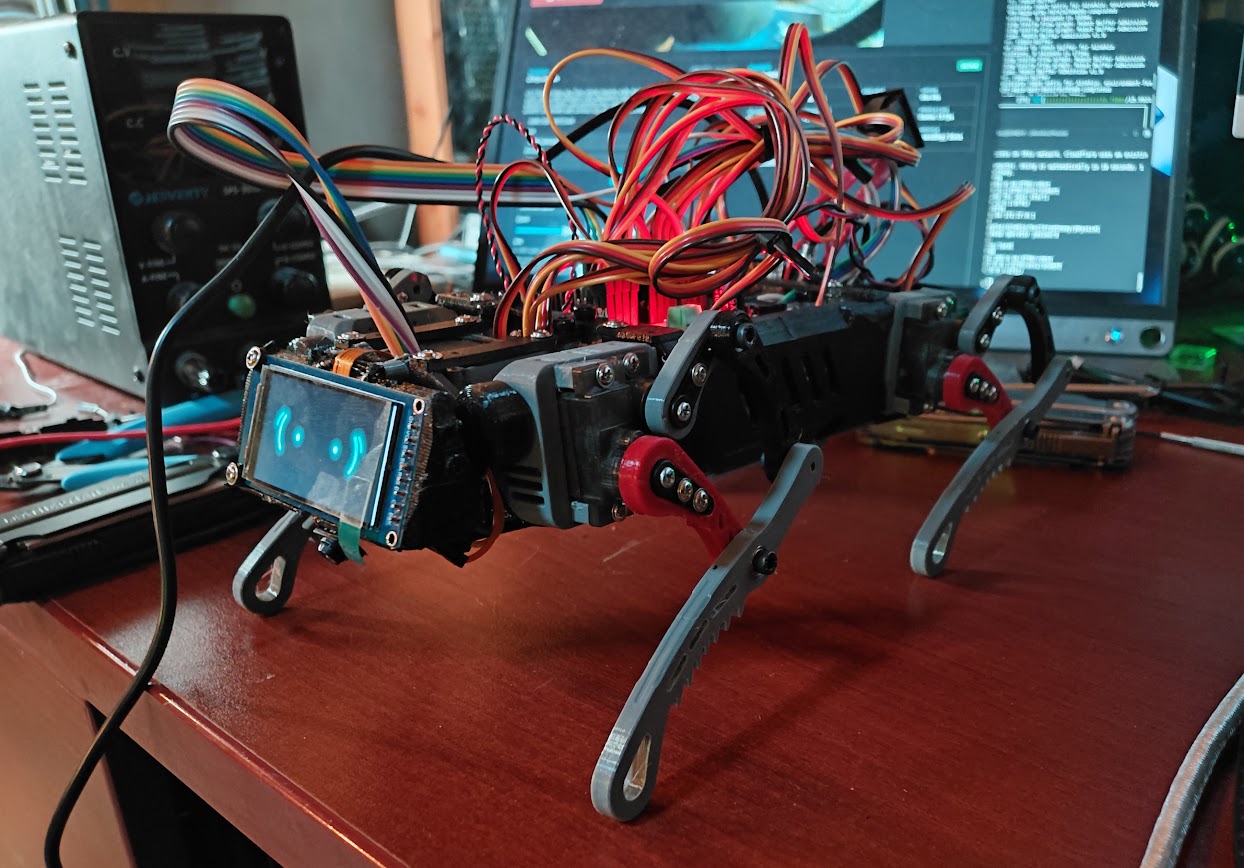
Two days of build progress, side by side
| Question | October 6 report | October 8 report |
|---|---|---|
| Can the assembled robot stand? | The printed chassis could not stand on its MG90 servos | The robot can stand |
| Can it walk? | Revised parts were still printing; the new assembly had not been tested | Walking |
| Does it respond to commands? | The entry focused on the failed standing attempt and rebuild | Responds to commands |
| What is fitted? | Chassis printed; LCD and shell pieces not printed for that attempt | Photo shows the exposed assembly and illuminated LCD; carapace pieces are not attached |
| Active Operator | No physical acceptance result | Explicitly not tested |
| Weight and lifting force | Approximately 20% lighter and 20% more lifting force were estimates | No new measurements supplied; those estimates remain estimates |
| Battery endurance | Not measured | No runtime measurement supplied |
Still to measure: walking speed and distance, behavior on different surfaces, endurance, and loaded gestures. I also need to record the installed calibration and part revisions.
The printed-part record is growing
All design work continues in Blender. The robot repository now includes more of the printable hardware behind the assembly. The table lists the latest export revisions.
| Assembly area | Newly recorded files | Where to inspect them |
|---|---|---|
| Compact legs | 35 mm carrier exports, plus 20 mm recessed-horn cranks and 28 mm pickup parts | October 7 hardware snapshot |
| Electronics and power packaging | Wireless bridge, board retainers, battery cradle and rear power-carrier parts | October 7 export set |
| Display support | Left/right front-panel braces and the LCD carrier | October 8 LCD support exports |
| Speaker mounting | A holder identified in the source as “Speaker holder - 20x30” | October 8 speaker housing |
The current local work also includes camera-carrier and longer front-tray exports. Those are still uncommitted at this review. They are not included in the linked repository snapshots above.
The parts and assembly guide retains earlier options, prototype photographs and print downloads. The compact-linkage study explains the 35/20/28 mm candidate and its remaining reach/travel questions. The new walking report does not identify the exact firmware/model revision used, so it should not be used to declare every offline motion or clearance check complete.
The face is now part of the physical build
The photograph shows the wide LCD displaying its cyan resting expression. The firmware records also document October 6 LCD/camera orientation fixes, a working-speaker report, and wake-word transport checks. The face and media update separates those device records from the newer local expression refinements.
MetaHuman and Body Control have also changed: request handling, conversation, task planning and connection selection are being developed together. The responsive-command update describes that software work and its current test boundaries.
What remains to document
The carapace still needs attaching, and Active Operator needs its own test. Useful next measurements are the assembled mass, exact power arrangement, walking settings and duration, and the flashed firmware/calibration revision. None of those values is inferred from the photograph.
Sources: the owner’s October 8 report and photograph, the linked hardware commits, and the source and image manifest. The gait journal now records this physical milestone alongside the earlier calculations and unsuccessful standing attempt.
Standing, Walking, and Responding to Commands
https://ainek.io/posts/2026-10-08-standing-walking/