V2 · 12 servosDated experiment
YOLOE: From Person Detection to Selected Targets
A desktop YOLOE pilot now searches and tracks using the robot camera. Follow the live chair result, exact-frame selection, model limitations, and remaining integration work.
Published 3 min read
Search, select, and keep the right image
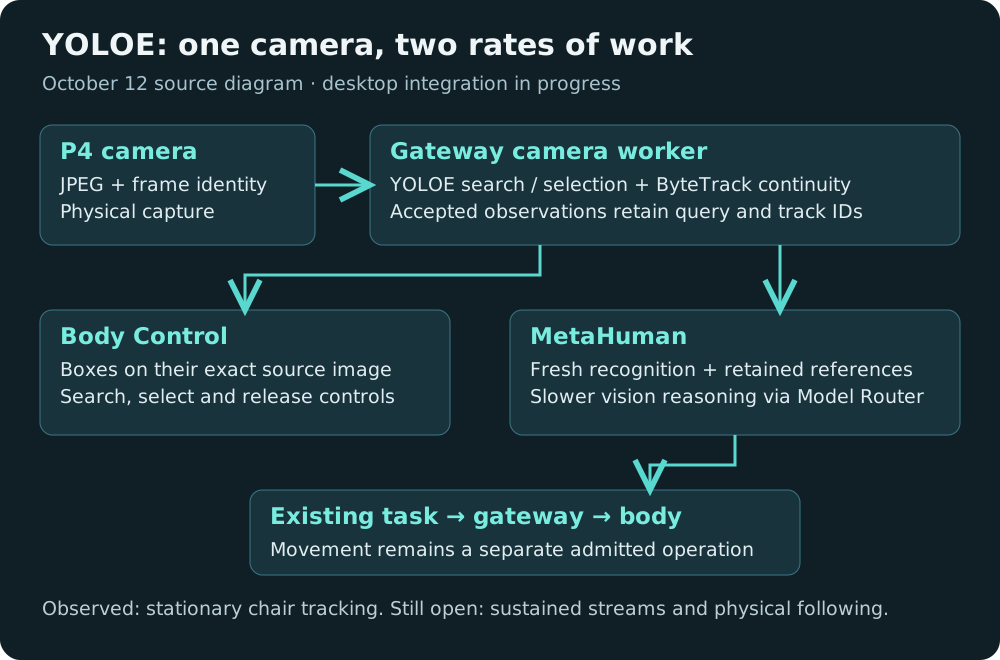
YOLOE integration has moved beyond the earlier person-only detector experiment. The October 11 record documents a desktop pilot using YOLOE-26n-seg, MobileCLIP2-B for text prompts, and ByteTrack for continuity between frames. On October 12, real P4 camera observations reached MetaHuman, and a stationary chair-selection test retained a track across eight observed frames.
Moving-target tests and Q6A benchmarks are still pending.
What the detector can be asked to do
| Operation | Earlier detector | Current desktop pilot |
|---|---|---|
| Default view | Person-only YOLO checkpoint | Prepared YOLOE person vocabulary, retaining the familiar starting view |
| Text search | Fixed checkpoint classes | Search for a named category using local text embeddings |
| Visual selection | No general reference-target workflow | Submit a region together with the original reference JPEG |
| Continuity | A detection in one image | Track IDs associated across accepted frames with ByteTrack |
| Release | No selected-target mode | Release selection and restore the configured default person detector |
| Operator view | Camera/recognition health | Exact-image detection overlays, text search, selection and release |
A track ID estimates continuity. It does not prove a person’s identity or that a similar replacement is the same object. Named-face recognition remains a separate annotation. The existing camera worker owns inference and tracking; these features do not create another camera stream or a second movement sender.
October 12: a chair through the real camera path
| Check | Recorded result | What it establishes |
|---|---|---|
| P4 camera → gateway → MetaHuman | Real person detections and track IDs arrived; a Coordinator read returned the robot JPEG with its complete source identity | Live camera/bridge data flow on the desktop |
| Text search for chair | Chair observations carried the search query ID and a track ID | Live category search through the existing request owner |
| CPU Qwen 0.8B acquisition | About 10.2 s; returned an ambiguous, imprecise chair region | Actual model inference occurred, but localization was weak |
| Tracking from that candidate | Selection receipt succeeded; no detections in 13 distinct observed frames | Selection accepted; tracking failed |
| Tighter region on the same reference image | Chair detected in all eight observed frames, with one track ID; scores 0.37–0.65 | A live stationary selected-target result for this particular reference |
| Sustained camera session | Reconnects occurred; later frames stopped while heartbeats continued | Camera recovery remains unresolved; toggling the saved camera setting off/on restored frames |
The Qwen trial used the base 0.8B model and its vision projector on desktop CPU, without the trained intent/task adapters. It is not a Q6A benchmark or a result for the separate 9B vision model. The camera tests issued no body movement commands.
Why the exact reference matters
A selected box belongs to one image, not to whichever frame arrives next. Search and selection carry their query identity, and visual selection retains the original JPEG and gateway/robot/session/frame identity. Body Control draws boxes over the image that produced them. MetaHuman receives fresh recognition through the same bridge and keeps older observations as history.
The local source now lets Environment vision choose a model through the existing Model Router. This removes a forced remote placement that had selected an adapter unable to accept images. The intent and task specialist assignments remain independent. The October 12 integration record says the new Site build was prepared, but its vision-handler update had not yet been activated in the running process at that checkpoint.
What the earlier trials taught
Desktop fixture trials found limits that are still relevant. A visual person reference returned no detections at detector size 320, but two people at 640; that did not isolate one intended individual. A wheel reference returned none at either size. Qwen also confused a front-wheel request with the rear wheel.
The live chair test advances beyond those fixture checks, while leaving independently moving targets, crossings, occlusion and reacquisition to test. Physical following also needs the selected-track loss policy reconciled with the existing single-person behavior. The last Cloudflare route check returned 502; neither that route nor Q6A throughput is qualified by the desktop pilot.
Next work is to activate and exercise the complete conversational acquisition path, investigate camera-stream recovery, and test continuity under actual motion before enabling physical following.
Sources: the October 12 local camera/tracking integration record, gateway source, and MetaHuman image-routing changes, identified in the source manifest. The committed October 9 camera-health work provides an earlier public baseline; the newer integration is still local work.
YOLOE: From Person Detection to Selected Targets
https://ainek.io/posts/2026-10-12-yoloe-tracking/