V2 · 12 servosDated experiment
Listening to the servos: feedback wiring and a rebuilt chassis
Twelve modified servos, a CD74HC4067 multiplexer, measured-position tools and revised chassis parts give Ainekio a way to check what its joints actually did.
Published 4 min read
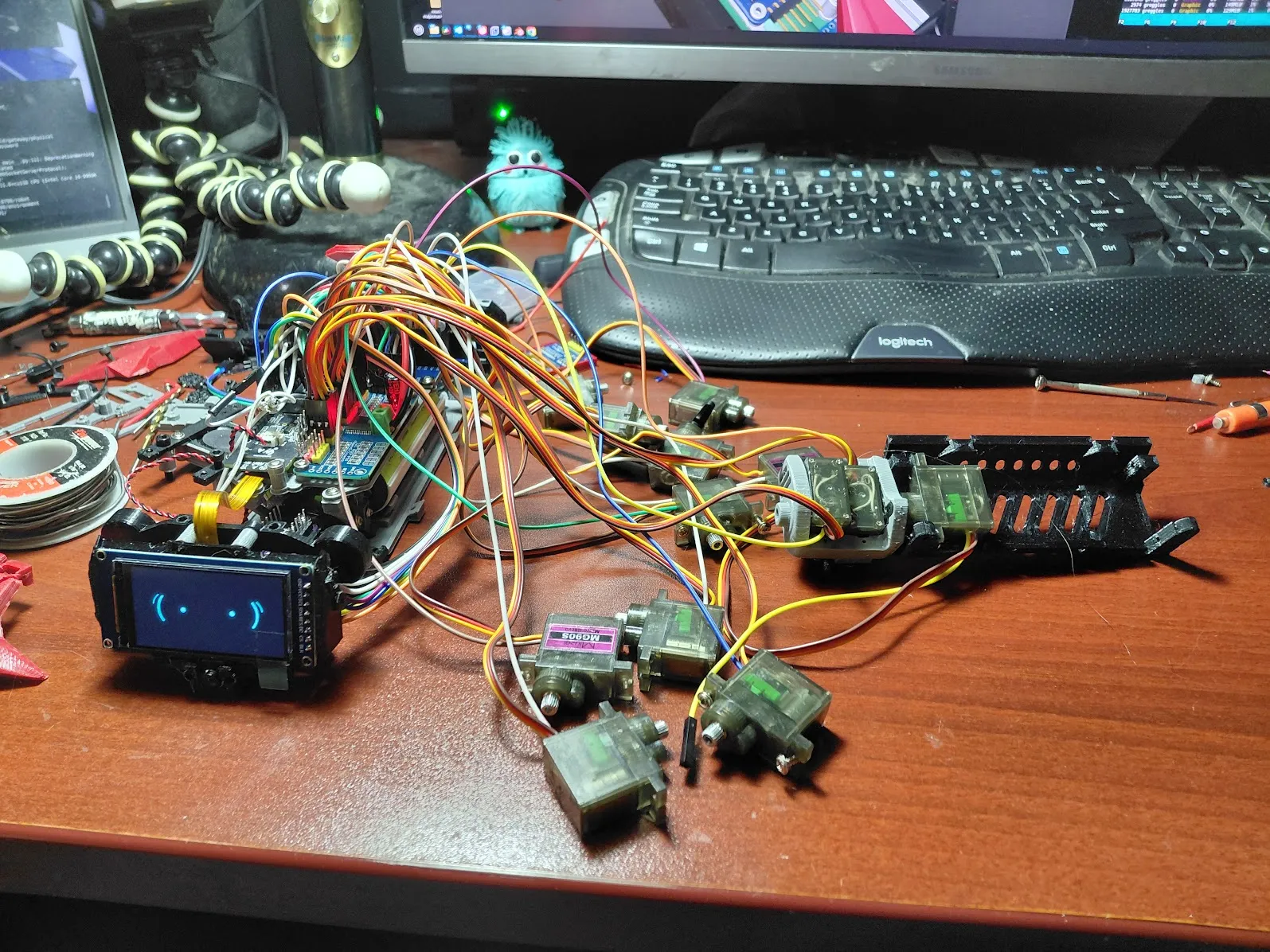
The latest rebuild adds a fourth wire to each of V2’s twelve servos and a CD74HC4067 analog multiplexer. It gives the ESP32-P4 a measurement from each servo’s internal position sensor. Body Control can now show the difference between a requested position and the position reported by the servo.
This addresses a concrete problem in the walking experiments. Sending a position command did not establish that a loaded leg had reached it. October 16 floor trials still showed a sagging rear, dragging feet and weak movement at smaller strides. Legs could extend unloaded while the assembled body struggled to rise. No gait winner or reliable walking distance was established in those trials.
The October 8 standing-and-walking milestone remains part of the build history; it did not establish repeatable locomotion across later revisions.
The extra wire and the multiplexer
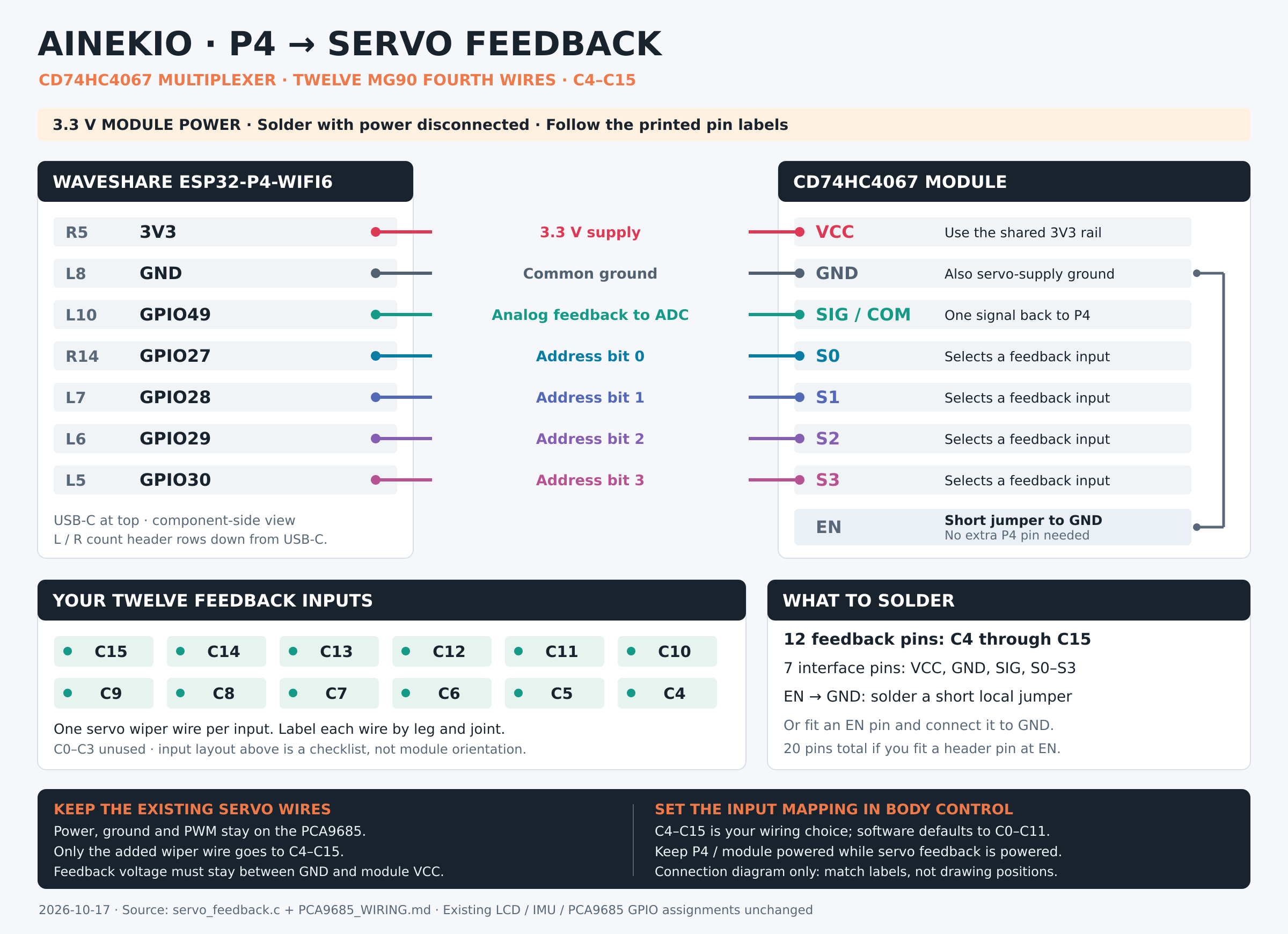
The added wire reads the servo’s internal potentiometer wiper while retaining its original connection. The servo still has its own internal controller. The PCA9685 continues to send PWM commands; the new multiplexer carries analog feedback in the other direction.
Twelve feedback wires connect to mux inputs C4 through C15. The P4 selects one input at a time and reads it through its ADC, building a set of joint measurements without needing twelve separate ADC pins. Each reading carries sample age and spread, so a stale or noisy observation can be distinguished from useful position evidence.
This measurement concerns the servo shaft. It does not directly measure foot contact, joint torque, body height or distance traveled. Linkage geometry, mechanical play and load still matter. The IMU complements it with body attitude, acceleration and rotation; a level IMU alone cannot tell a standing robot from a stationary crouch.
What the physical checks established
The October 17 record confirms 0.8.64-p4-lcd-restored running on the P4 with the feedback feature available. All twelve loose servos responded on their assigned mux channels during individual movement checks.
Each servo then received a saved three-point calibration at 500, 1650 and 2800 microseconds. These are recorded calibration points from an unloaded test with clear horns, not a recommended motion range for an assembled leg. Intermediate checks covered 48 positions and 480 settled observations:
| Check | Recorded result |
|---|---|
| Calibrated joints | All twelve; socket N mapped to mux C(N+4) |
| Largest absolute median difference from command | 15.31 µs in estimated pulse-equivalent position |
| Largest individual difference | 23.34 µs |
| Existing arrival tolerance | 30 µs; unchanged during the checks |
| Saved operating state | Feedback acquisition enabled; measured Stand disabled |
These results establish unloaded command/feedback agreement. They are not an independent angular-accuracy measurement or proof that the legs can lift and carry the robot. Saved motor Home, direction and output mapping were preserved.
What changes in Body Control
The Servo Feedback tool exposes raw readings, input-to-joint mapping, calibration points, sample freshness and measured-versus-commanded position. Acquisition and feedback-guided standing have separate saved controls.
The new Stand path can start from measured positions and advance its leg stages when fresh feedback confirms arrival. In that path, a shoulder change follows the measured leg lift instead of assuming elapsed command time means the lift happened. Acquisition runs separately from motion control; this does not create a global command barrier, and replacement commands remain available. Missing readings cannot count as successful arrival.
Feedback-guided Stand remains off in the latest physical record. Reassembled, supported tests are the next step. Continuous walking is not yet qualified by the servo calibration.
Repackaging the body
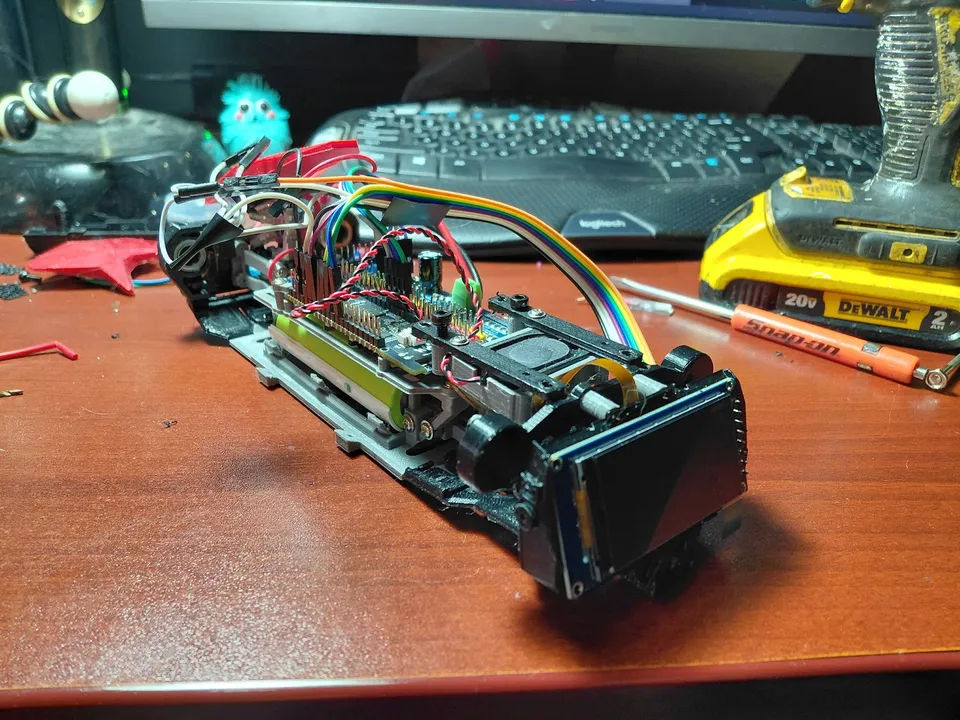
The feedback rebuild accompanies substantial chassis work. The latest local prototype exports include a revised battery cradle, a lower electronics slot, an extended front tray, extra front servo housings, a forward gyro carrier and board retainers, a battery-mounted keeper bridge, and four LCD-carrier spacers.
These parts address how the electronics, wiring, face and moving legs fit within the body. Their presence in the design files does not establish that every part is printed, installed or fit-tested. The earlier 566 g assembly report is dated October 13; a new complete mass and endurance measurement is still needed.
Evidence and next steps
This report uses the October 16–17 entries in the robot’s gait research journal, the feedback driver and calibration model, wiring documentation, and the local chassis export inventory inspected on October 18. The source snapshot records paths and hashes, including working-tree changes that may not yet be published upstream.
The next physical questions are whether the assembled linkages reach their targets under load, whether measured standing restores useful body height, and how that evidence informs repeatable walking. The new feedback makes those questions measurable; it does not answer them in advance.
Listening to the servos: feedback wiring and a rebuilt chassis
https://ainek.io/posts/2026-10-18-servo-feedback-and-chassis/