V2 · 12 servosDated experiment
Freestyle: teaching targets, speed and recovery
Editable motion examples, compact Qwen inference on the Q6A, measured shaft arrival, and the October 26 Stand-training results.
Published 4 min read
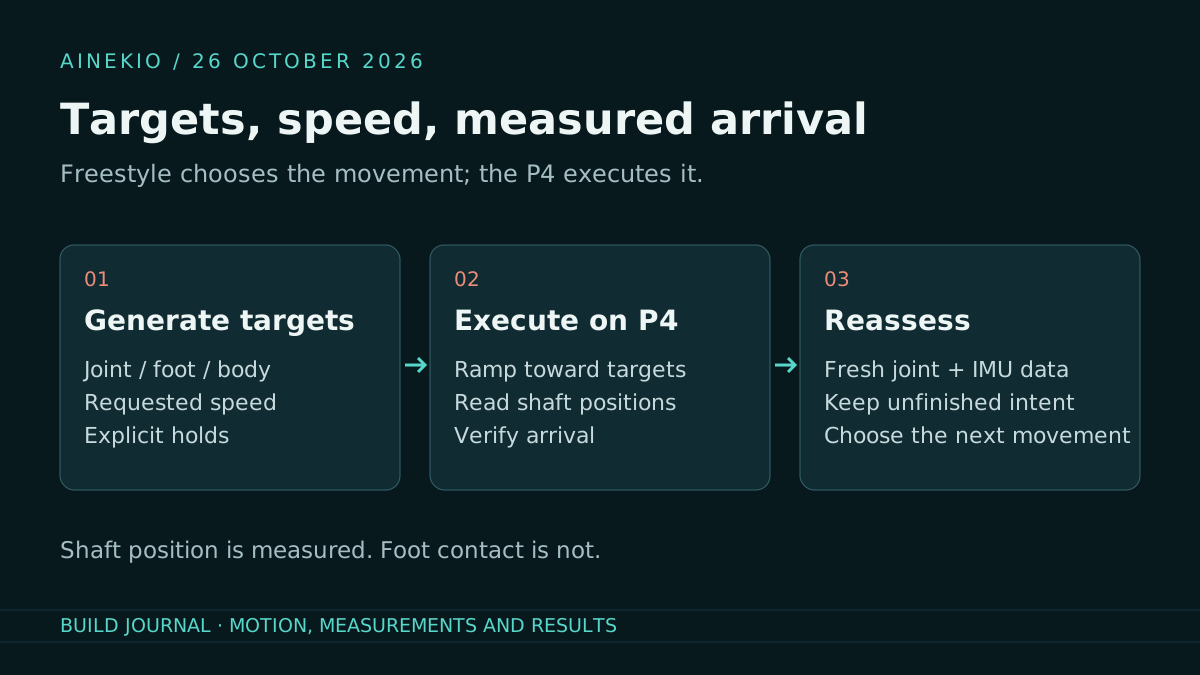
The new motion work asks a small trained model to generate joint, foot and body movements from a request and the robot’s measured state. Freestyle now has an editable training library, compact output, and a target-and-speed execution path. The existing gait solver still handles gait execution.
This is a different experiment from the October 21 Walk/Run optimizer. That loop compares gait parameters during normal walking. Freestyle learns how to turn an instruction and feedback into a sequence of movements.
From timed frames to measured arrival
| Part of a motion | Earlier generated sequences | New target-and-speed path |
|---|---|---|
| Requested movement | Joint/foot/body operations compiled into timed frames | Joint/foot/body targets with speed_pct |
| Advance to the next target | Sequence timing | Fresh shaft feedback confirms arrival within the configured tolerance |
| Deliberate pause | Authored duration | An explicit hold retains its duration |
| Something has not moved as expected | Record the discrepancy and request correction | Retain the target and powered support; send current measurements and unfinished intent for reassessment |
| Start another request | Existing Stop/replacement behavior | Same owner; pending arrival does not prevent replacement |
The fourth wires measure servo shafts. They do not measure whether a foot is actually touching the floor. Foot clearance is calculated from linkage geometry and attitude, so carpet contact and loaded motion still need observation.
The current 0.8.127 firmware source moves boot/wake standing and inactivity
rest requests to Freestyle. Manual Body Control retains the legacy library.
This change needs matching model, host and firmware versions; the October 26
model activation did not flash the robot. The separate body entry
records the latest supported firmware trials.
Editing what the model will learn
Body Control’s motion library exposes the exact compact training input and target. I can edit a movement, send that draft directly to the robot, review the result, and export the dataset for another training pass.
| Control | What changes |
|---|---|
| Save training example | Updates the local library; superseded targets are replaced |
| Send motion to robot | Executes the displayed target, including unsaved changes, without another model call |
| Export training data | Downloads the current training split, held-out files and matching tool contract |
| Train and activate | Produces and selects new weights; saving an example alone does not update the model |
The October 25 working-library record contains 889 active examples after six superseded targets were removed. A committed training snapshot can travel between machines; the working SQLite database and model weights remain local. Later Stand training uses its own frozen dataset, rather than treating every library edit as already learned.
Q6A inference and physical corrections
The compact Q6A model reduces the text needed to describe the same motion. For one uncached happy-face/10 mm foot-lift request, the recorded comparison was:
| Q6A CPU measurement | Earlier v8 | Compact candidate |
|---|---|---|
| Input tokens | 3,154 | 823 |
| Output tokens | 91 | 49 |
| Generation time | 72.89 s | 17.90 s |
| Decoded operations | 4 | 4 |
| Authored movement time | 2 s | 2 s |
These are individual requests, not average response times. A later check of the activated model took 10.23 seconds for the same frozen request.
The first physical foot-lift attempt failed my visual review. A repeat after a power cycle and Stand setup worked, but subsequent small lifts were too subtle, slow and disturbed balance. A rear-crouch/25 mm brisk-lift correction passed review and was saved for training.
A separate rear-sway trial exposed a host preparation bottleneck. Moving IK preparation out of the gateway’s Python thread reduced the same authored 2.8-second sway from 9.96 to 5.03 seconds end to end. Shortening the authored sway to 1.28 seconds produced a 2.54-second trial that I approved. The recorded shaft discrepancies remain; the approved example was still pending retraining.
October 26: learning to acquire Stand
The latest continuation uses 1,261 examples: 900 general-motion examples and 361 feedback-conditioned Stand examples, including 40 synthetic starting geometries. The teacher uses the existing posture solver and installed servo mapping. Its examples cover lift/place/lower, lag, slip, settling, completion and gyro attitude. They are geometric training examples, not successful robot trials.
| Evaluation | Earlier v8 | Stand-entry-balanced |
|---|---|---|
| Requests attempted | 148 | 148 |
| Completed outputs | 147 | 146 |
| Reference matches among 145 mutually completed cases | 26 | 59 |
| Target translation/compilation failures in each run | 26 | 12 |
Reference agreement improved, but the model still struggles to reach Stand from other starting poses. In three offline trials that fed each generated result into the next request:
| Starting case | Result |
|---|---|
| Already standing | Raised, returned to nominal and finished in three responses |
| Lower starting posture | Finished with a maximum nominal-joint error of 53.51° |
| Held-out spread-leg posture | Repeated an off-target pose through all 24 evaluation rounds |
Only the already-standing case reached the geometric goal. One compound request also grew from a 58-call reference to 476 generated calls. Three later ending-data corrections are not included in these weights.
After reviewing those failures, I activated the Qwen3.5-0.8B LoRA exported as Q8_0 on the workstation on October 26. The live API returned a nominal-Stand program in 0.663 seconds, using a saved synthetic observation and sending no robot commands. The Q6A deployment was not changed. The failures above remain the next training work: entry selection, advancing after arrival, and stopping when the requested movement is complete.
Records
Download the evaluation summary
and source record.
The reviewed files are experiments/freestyle/README.md, CURRICULUM.md,
program.py, the frozen stand-entry-balanced/final-review.json, and its later
activation/verification.json. The activation record supersedes the evaluation’s
earlier “not deployed” status; it does not change its scores.
Freestyle: teaching targets, speed and recovery
https://ainek.io/posts/2026-10-26-freestyle-targets-and-training/