V2 · 12 servosDated experiment
Freestyle runs once: finite motion, recovery and a supported stretch
The new finite-event motion model, 339-example continuation, real-event recovery and a supported stretch trial with all nine positions verified.
Published 3 min read
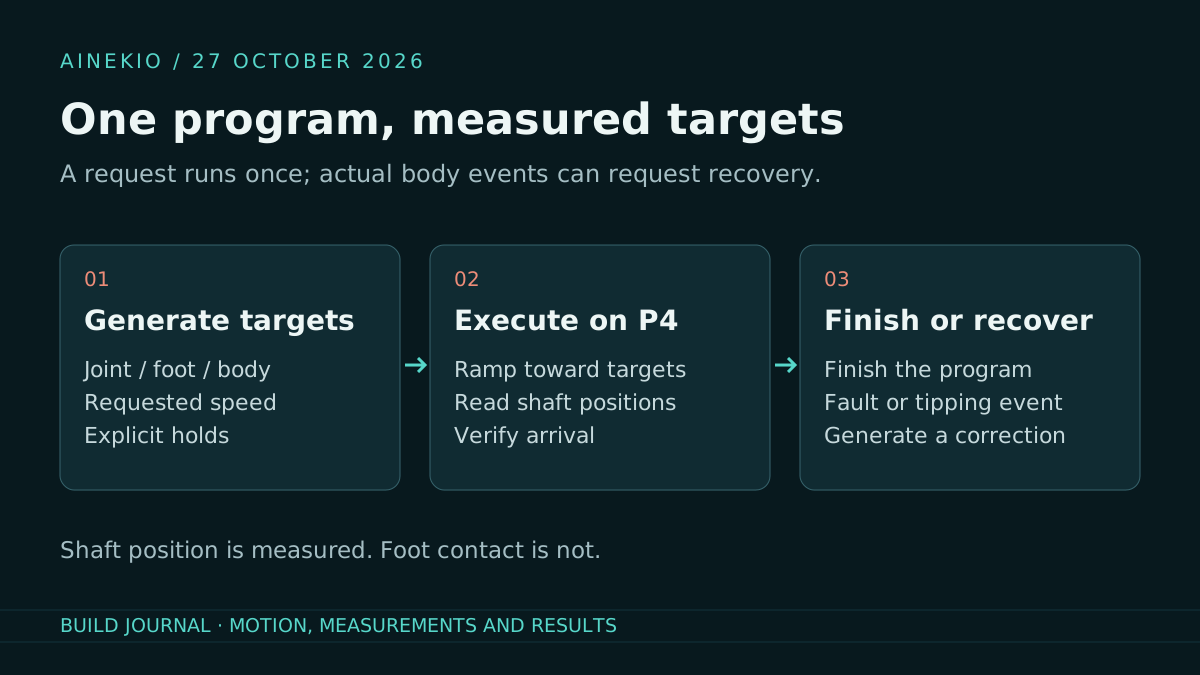
Freestyle now produces a complete movement program and runs it once. Reaching its final target does not call the model again. Actual stall, feedback-fault and tipping events can still request a correction.
This replaces the model-requested continuation loop described in the October 26 training entry. One recorded recovery had repeatedly emitted a standing pose and another reassessment despite successful target receipts, producing periodic twitching. The continuation operation is now removed from execution and the maintained training contract.
A finite program, then an outcome
| Boundary | Current behavior |
|---|---|
| Ordinary request | Generate a complete joint/foot/body target-and-speed program |
| Target execution | The P4 ramps toward the target and checks fresh shaft arrival |
| Program completion | Finish the program; no automatic new inference |
| Actual fault or fall | Send the attributed event and measurements for a new correction |
| Unverified receipt | Keep it unverified; do not count it as a successful movement |
| Manual Stop or replacement | Retain the existing command authority and cancel superseded recovery |
The model now receives each joint’s calibrated feedback range, arrival tolerance, feedback usability and fault flags. That range describes where shaft arrival can be observed; it is not a mechanical stop or a new clamp on requested motion. There is no dedicated slip detector in this path; supplied slip events can use its recovery handler.
October 27 model activation
The workstation now serves the Qwen3.5-0.8B finite-event contrast LoRA, Q8_0, with its matching finite-command contract. The final continuation trained on 339 examples, including 116 synthetic contrasts for rest, release, holding before release, and remaining powered. The new contrasts were also added to the editable library and maintained training snapshot.
| Frozen comparison | Previous candidate | Activated contrast candidate |
|---|---|---|
| Reference matches on 34 shared cases | 20 | 24 |
| Matches on 28 new contrast cases | — | 16 |
| Total matches in the new 62-case comparison | — | 40 |
Both physically reviewed hand examples remained exact in this comparison. Against an idealized shaft simulation, the recorded idle request executed 13 geometric targets and then released outputs in one generation. Jam and tip requests also completed finite corrections.
The already-lying case unnecessarily repeated the rest path. Some requests to remain powered and some wave counts are still wrong. I activated the candidate with those misses retained for further training. This release has no new physical recovery trial, changed no remote Q6A deployment, and required no firmware flash.
A supported stretch worked
The October 27 physical review records a successful supported stretch with all nine movement receipts position-verified and no adjusted targets. The left-crank Home mapping was corrected to −117.68° at 2750 µs. That particular trial needed 84.82° left-crank extension versus 64.63° on the right.
I do not want that device-specific compensation baked into a generic stretch. The training motion should remain in geometry space, with each servo’s mapping handled by calibration. The successful trial is retained as evidence; a replacement generic training target awaits matching physical calibration references. Obsolete stretch examples were retired without changing the frozen test records. Starting from a sagged, released pose remains unproven: the successful trial began after positioning through the calibration controls.
Keep fitted and requested targets distinct
Firmware source 0.8.128 resolves a Freestyle endpoint once, then uses the same
resolved goal for ramping and shaft-arrival checks. It also retains the authored
target. If fitting changes a joint, the result reports the adjustment and leaves
position_verified false for the original request.
That repair has native replay coverage for the recorded failed Wave. Its source record does not establish installation or a loaded physical retest. It addresses a specific distinction: arriving at an adjusted pose is not proof of arriving at the pose that was requested.
Next: reliable finite endings, correct release/keep-powered choices, matching physical calibration, and recovery trials on the actual body.
Records
The current Freestyle README and curriculum record the model activation and supported stretch. The P4 firmware README records resolved-target behavior. Source revisions and hashes.
Freestyle runs once: finite motion, recovery and a supported stretch
https://ainek.io/posts/2026-10-27-finite-motion-and-recovery/