Ainekio is a four-legged robot familiar being developed as a persistent
conversational companion. The aim is a recognizable personality that carries
experience from one interaction into the next: talking, noticing its surroundings,
expressing itself, choosing activities and learning from what happens.
Its body provides movement, a camera, a microphone, a speaker and a face display.
MetaHuman OS provides the software for identity, conversation, memory,
perception, decisions and learning. Body Control connects the two and gives the
owner a manual interface. The original eight-servo V1 and the twelve-servo V2
have different physical capabilities; the connected body’s capabilities determine
which actions are available.
This guide describes the companion’s intended functions and the systems being
built to support them. The complete companion experience is still in development.
Current status and the dated build reports record what
has been tested and what remains unresolved.
The latest Full Auto trials carry an
intention through a status result but still do not develop it into sustained
activity. Freestyle training
works on another part of the companion: turning requests and joint feedback into
expressive motion. The new model’s Stand-acquisition failures remain visible
alongside the individual gestures that worked.
Respond through text or speech, follow the exchange and connect an answer to the relevant situation
Perceive
Use camera observations, recognition and body sensing to inform answers and activities
Move and express
Combine supported postures, gestures, locomotion, speech and face expressions
Remember
Retain useful experiences and retrieve them for later conversation and decisions
Pursue goals
Keep track of an objective, choose steps, examine results and decide what to do next
Reflect and imagine
Produce attributed internal reflections, dreams, daydreams and questions that can contribute to later activity
Learn
Use reviewed interactions and corrections to improve specialist skills and, ultimately, conversational personality
These functions belong to one companion. For example, an intended request to
help find an object would connect conversation, visual evidence, selected
actions and review of the result. The model chooses the steps from the situation;
there is no fixed search routine for every object. Reliable autonomous search
and navigation still require their own demonstrations.
An agent coordinates a function; its node workflow connects context, model calls
and results. A model category assigns a responsibility to each call, while the
status widget selects the concrete model. Active Operator coordinates the
selected autonomy mode; Body Event Trigger interprets physical events.
Orchestrator routes the request, Task Decisions selects supported actions,
Vision handles visual evidence, and Planner handles complex planning. Persona
owns the outward reply using selected results and applicable assessment.
Task no longer inserts speech steps between motions. This separates action
selection from expression while allowing independent work to overlap.
Ainekio’s persona describes its identity, background, personality, values and
goals. Relevant parts can inform how it responds and what it considers doing.
The aim is consistent character with reactions appropriate to the moment.
Variation should come from context, experience and model choices.
Personality and memory play different roles. A persona can describe an interest;
a memory records a particular experience. A generated story or imagined event
must remain distinguishable from something the robot actually observed.
Three forms of continuity work together:
Recent context keeps the current conversation and relevant internal activity available across successive turns.
Persistent memory stores experiences beyond that recent context and retrieves useful records later.
Saved task progress retains an objective, corrections, actions and results while work continues.
Model training is a fourth, slower process: it changes learned behavior. Saving
a conversation does not immediately train the model, and a trained model does
not automatically contain the current conversation.
MetaHuman includes workflows for reflection, dreams, daydreams, curiosity,
associative thought and mood review. Reflection examines supplied experience;
dreams and daydreams produce imaginative material. Some internal activity may
inform a later conversation or choice without being spoken as it is generated.
Here, “inner activity” names software-generated content, not a claim of subjective
experience.
The software’s Sleep Workflow brings together memory organization, curation,
eligible personalization training, desire processing, dreaming, persona review
and memory-index refresh. Which stages run depends on their settings and results.
This cognitive maintenance is separate from putting the physical body into
Doze or a low-power state. A body waking up does not mean a software sleep
cycle has completed.
The intended connection is that useful material remains available and can
influence later interaction. Recorded tests have found dreams that were saved
but did not reach the answering model. Generation, storage, retrieval and
use therefore remain separate parts of the work to verify.
Respond to requests and physical events without independently choosing new activities
Semi-autonomous
Let configured agents and triggers initiate selected functions and activities
Fully autonomous
Choose high-level activities, pursue goals, review desires and use outcomes to decide what comes next
A persona goal is a longer-term developmental or aspirational direction.
A desire is a specific desired outcome managed in Agency. An execution
objective identifies what a particular task should achieve. An action is one
step toward that outcome.
Completing a camera capture, for instance, does not prove that a missing object
has been found.
Full autonomy is intended to support purposeful, varied activity with continuity.
Repeated commands without progress do not demonstrate that capability. Ordinary
conversation also has value on its own; every exchange need not become a
physical task or a new goal. The autonomy guide
explains the operating modes and their development history.
The new locomotion goal interface describes
a measured distance, relative turn, target relationship or visual endpoint
alongside gait controls. The task receives progress evidence and the outcome of
finishing that movement. A motor setting or completed gait cycle does not prove
arrival. Installed support is recorded; calibration, model selection and physical
accuracy still need qualification.
Desire review can consider standing goals, attributed memories, selected-robot
status, capabilities, original requests, chosen actions and actual results.
It can revise an intention’s strength or archive it when it is no longer
warranted. Agency’s All Open view includes desires that are not yet active.
The Psychotherapist agent reviews experience for persona changes during manual
review or Sleep. It is the sole autonomous persona editor; ordinary Desire
reinforcement no longer creates persona goals. Using the Psychotherapist model
category for a Desire call does not give that workflow authority to edit persona.
Manual persona editing remains available.
These implemented boundaries improve what the models can assess. They do not
establish that every assessment is correct or that a complete learning cycle
has been qualified.
The project has two related learning directions. Specialist training improves
functions such as interpreting intent and selecting task actions. Conversational
personalization aims to teach the model Ainekio’s identity and expression from
reviewed companion replies and experience.
The latest recorded production arrangement uses trained Qwen3.5 2B Intent
and Task adapters on a shared Q8_0 base, with 9B conversation and vision.
A separate 9B autonomy adapter has an experimental assignment. Roles remain
configurable; the latest model report
records the comparisons, deployment decisions and remaining regressions.
Today, a persona description supplies identity through context. The longer-term
aim is a trained conversational persona that expresses that identity without
needing the full description repeated in every request. Selected memories,
current observations and instructions would still provide the information needed
for the situation. This is a development direction, not a claim that the learned
persona has already been deployed.
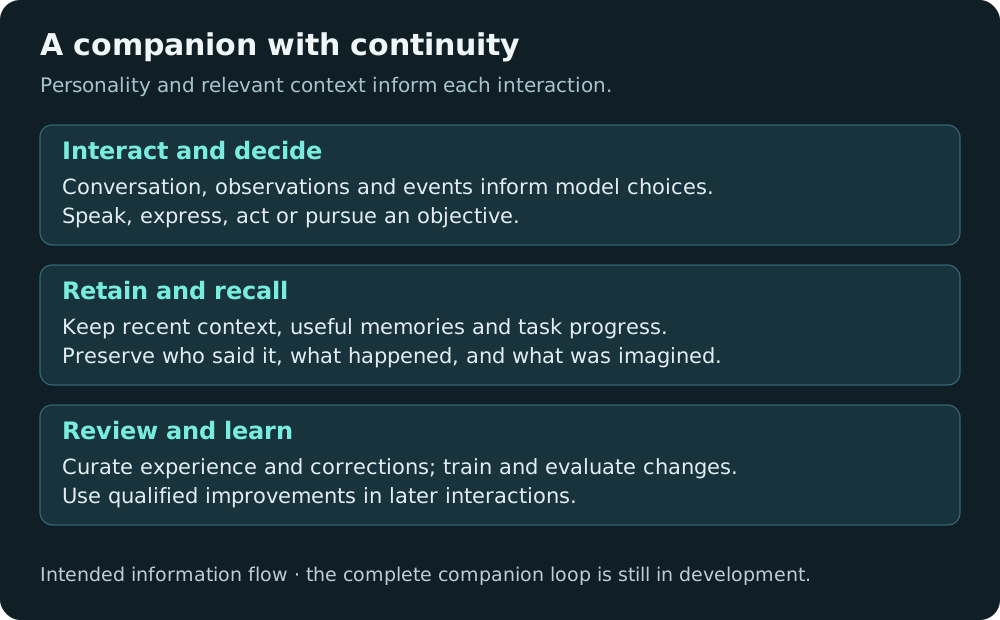
Information connects the functions over time. Independent work can overlap; this is not a required serial schedule.
Learning requires review and correction, training, comparison on separate test
cases, and a decision about deployment. Fluent replies and successful training
runs are not enough to establish improvement. The
Task training report shows why
better aggregate scores can still leave a candidate undeployed.
Motor-policy learning is now a
separate practical learning path: Body Control records joint, IMU and camera
observations, proposes compact Walk/Run policies and compares them on normal
commands. The P4 executes those policies locally. This is distinct from LLM
training, and the current automatic comparison has not demonstrated a better gait.
Fast Body Event uses the unadapted
2B base in a configurable Lightweight category for tip/shake speech, with preset
initial faces and no conversational memory capture. Boot/wake keeps its contextual
workflow. The body also has a successful ground-repair Stand trial and
an updated physical face.
The subsequent October 15–16 records add the deployed 2B specialists and an
explicitly experimental autonomy adapter. Both-speaker memory indexing and
camera freshness have repairs, while recall and visual grounding still fail in
some live cases. Version 20 memory-routing training data is prepared, not newly
trained. Read the October 18 update.
Two small independent 9B diagnostics for autonomy and conversational personality
completed on October 15. Serving tests still found lost objectives and invented
experience; neither adapter qualified for production. The
diagnostic report explains the limited
coverage and why lower training loss did not establish a better companion.
MetaHuman’s node editor exposes workflows, prompts, model roles and results.
Conversation, memory, persona and agency interfaces let the owner inspect
different aspects of the companion. Robot Status shows body evidence and task
state. Body Control supplies manual motion, sensing, audio and maintenance
controls for the selected robot.
Processing can be distributed between the body, a nearby computer and more
powerful compute. The body retains motor timing and peripheral control while
MetaHuman handles high-level cognition. Seamless transfer of an ongoing goal
between installations remains a separate development problem.
The test of this project is the connected experience: useful conversation,
appropriate action, remembered context and meaningful improvement. The current
work still includes reliable recall, sustained autonomy, voice delivery, correct
motion selection and physical validation. Individual working components are
progress toward that experience.
This guide adapts the purpose and functional descriptions in the local Ainekio
Robot Bible, reviewed through the October 19–20 records and inspected on October 21, 2026. The
original source record and
October 21 snapshot identify the evidence.
For dated results, follow the build journal and
development tracker.
Ainekio as a Companion: Personality, Memory and Learning