V2 · 12 servosDated experiment
Q6A, chassis work, and a more active loop
Q6A integration, the revised Ainekio v2 chassis, and the first pieces of a more active perception and control loop.
Published 2 min read
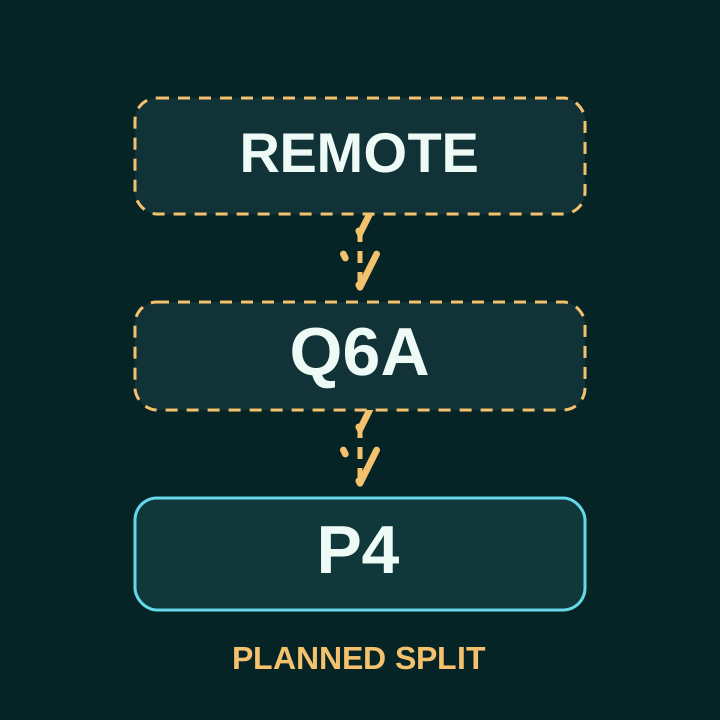
I’m working on the Q6A SBC integration, the Ainekio v2 chassis, and how to make the robot more active between LLM turns. YOLO is part of that research. The aim is to keep useful perception and movement running while the slower planning work catches up.
Q6A and the body
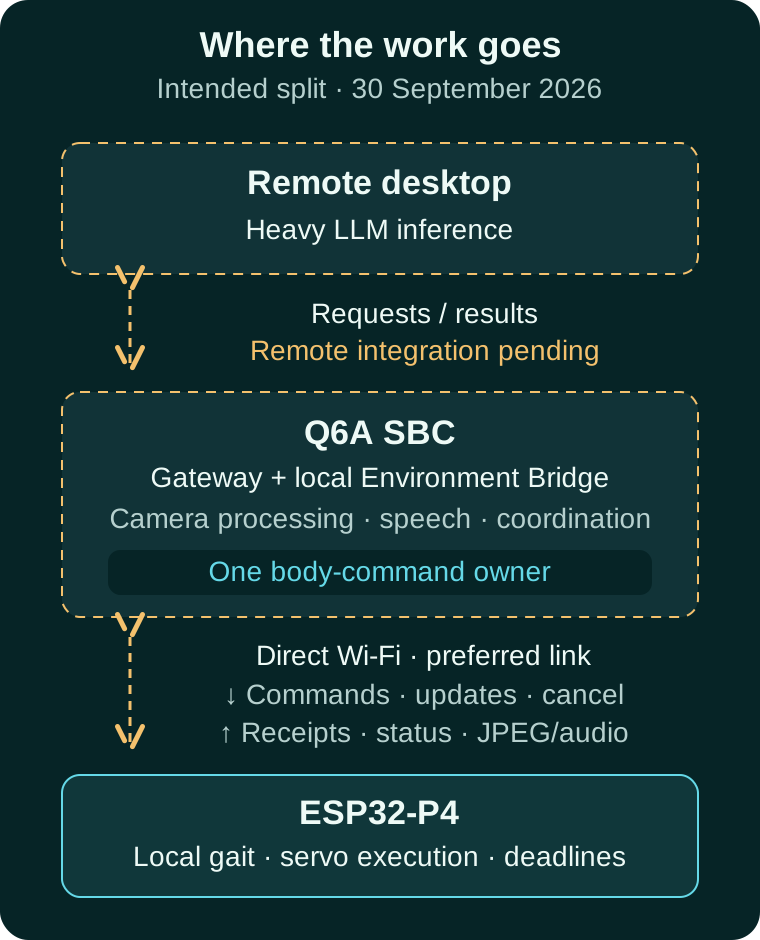
The current connection choice is direct Wi-Fi between the P4 and Q6A. USB stays an alternative, and ROS 2 is an optional integration layer. Gait execution stays on the P4; the host takes on perception and heavier planning. That split still needs testing under the combined camera, audio, and motion workload.
The latest chassis work adds Q6A mounting space and revises the shoulder geometry. All 47 motion sources were regenerated. The recorded checks cover software tests, model parity, and a P4 build; that geometry has not been flashed or tested on the powered body. Fit, balance, and loaded movement are still open.
From turns toward an active loop
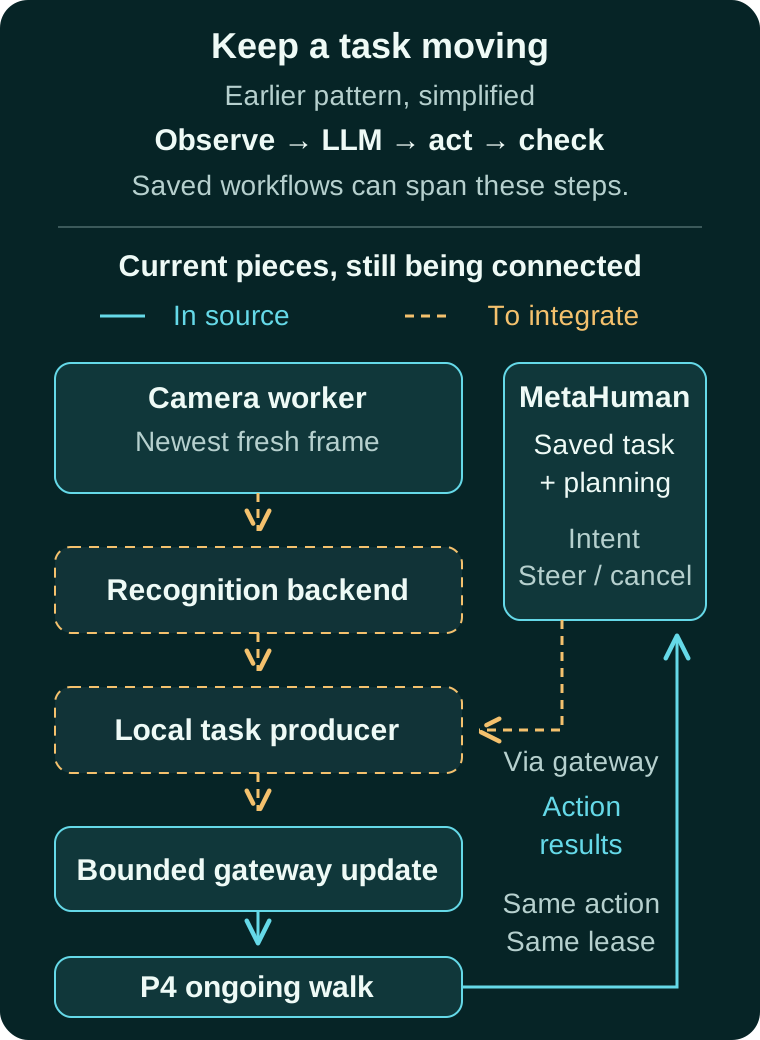
The gateway can now process fresh camera frames outside its receive loop. It also has an authenticated path for adjusting an ongoing walk’s speed or its stride/cadence settings while keeping the original action and body lease. Cancellation, expiry, and session checks still apply.
MetaHuman’s newly pushed workflow code carries an execution across waits and correlated results. New input can steer that saved execution, and visual observations can carry their frame IDs and timestamps forward. Those are useful pieces for moving beyond isolated request-and-response turns.
The recognition backend and MetaHuman’s local task producer still need joining up. No YOLO detection pipeline is selected or running through the gateway CLI, and the source checks do not establish an autonomous physical loop. Portable IMU estimation is also in the tree, but live acquisition and balance feedback are not connected yet.
Next on the bench
- Fit the revised body and check movement under load
- Bring up the intended Q6A services and measure them together
- Try recognition models on the assembled prototype, then connect fresh results to bounded movement updates
The original eight-servo S3 Ainekio remains supported alongside the twelve-servo Ainekio v2 work. The project index keeps the current work and source links in one place.
Source snapshot
Reviewed September 30 pushes: Ainekio 6437b24
and MetaHuman c3f56d4.
Details: body integration,
September 29 geometry checks,
and MetaHuman workflow ownership.
These pushes include earlier recorded work; the push date is not a new hardware-test date.
Q6A, chassis work, and a more active loop
https://ainek.io/posts/q6a-chassis-and-active-loop/