V1 + V2Build reference
Ainekio V1 and V2: Eight Servos Versus Twelve
Eight versus twelve servos: motion generation, measured feedback, processors and the current 650 g V2 battery/charger assembly, alongside dated motion ranges.
Published Updated 8 min read
Eight servos versus twelve
V2 adds a third actuator per leg, an ESP32-P4 controller and shaft feedback. The October 26 hardware record reports a 650 g assembly with a 2S battery, Mini560 converter and HiLetgo USB-C charger. The current Freestyle work adds model-generated targets and measured arrival to the existing gait solver.
The October 8 standing/walking report and later failed trials remain part of the build history. The latest supported Stand/Walk test repaired a firmware reboot; it did not establish loaded floor-walking quality. Current body results and latest motion-training results. The downloadable motion ranges below remain the September 24 snapshot.
Wireless, with the Q6A offboard over Wi-Fi, is the current priority. Wired remains an onboard-Q6A/native-USB design alternative; native USB is not an implemented replacement for the current Wi-Fi body-command path. The software update compares their status and separates implemented controls from hardware qualification.
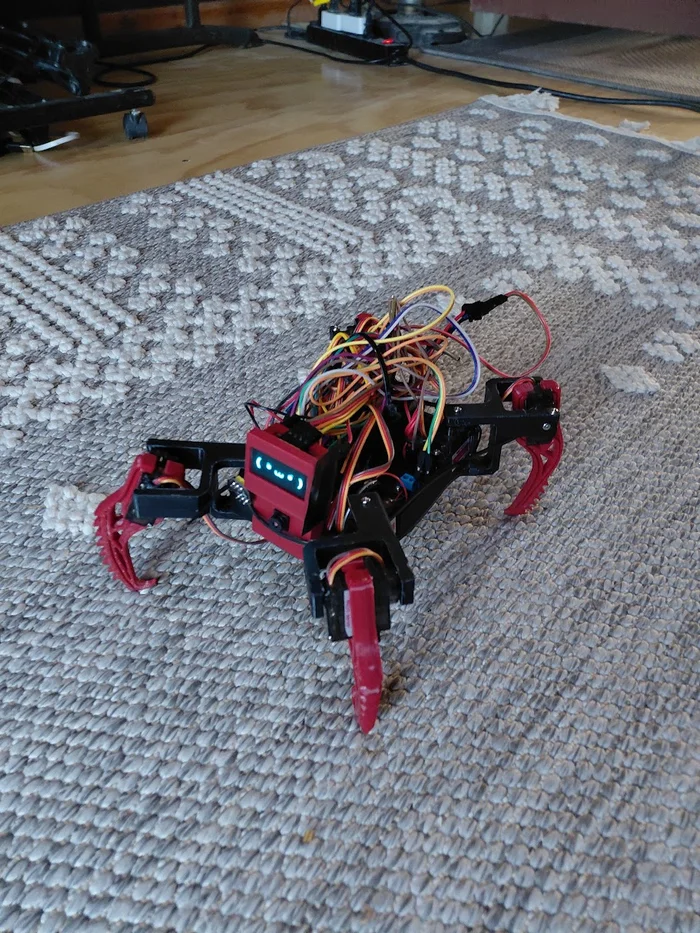
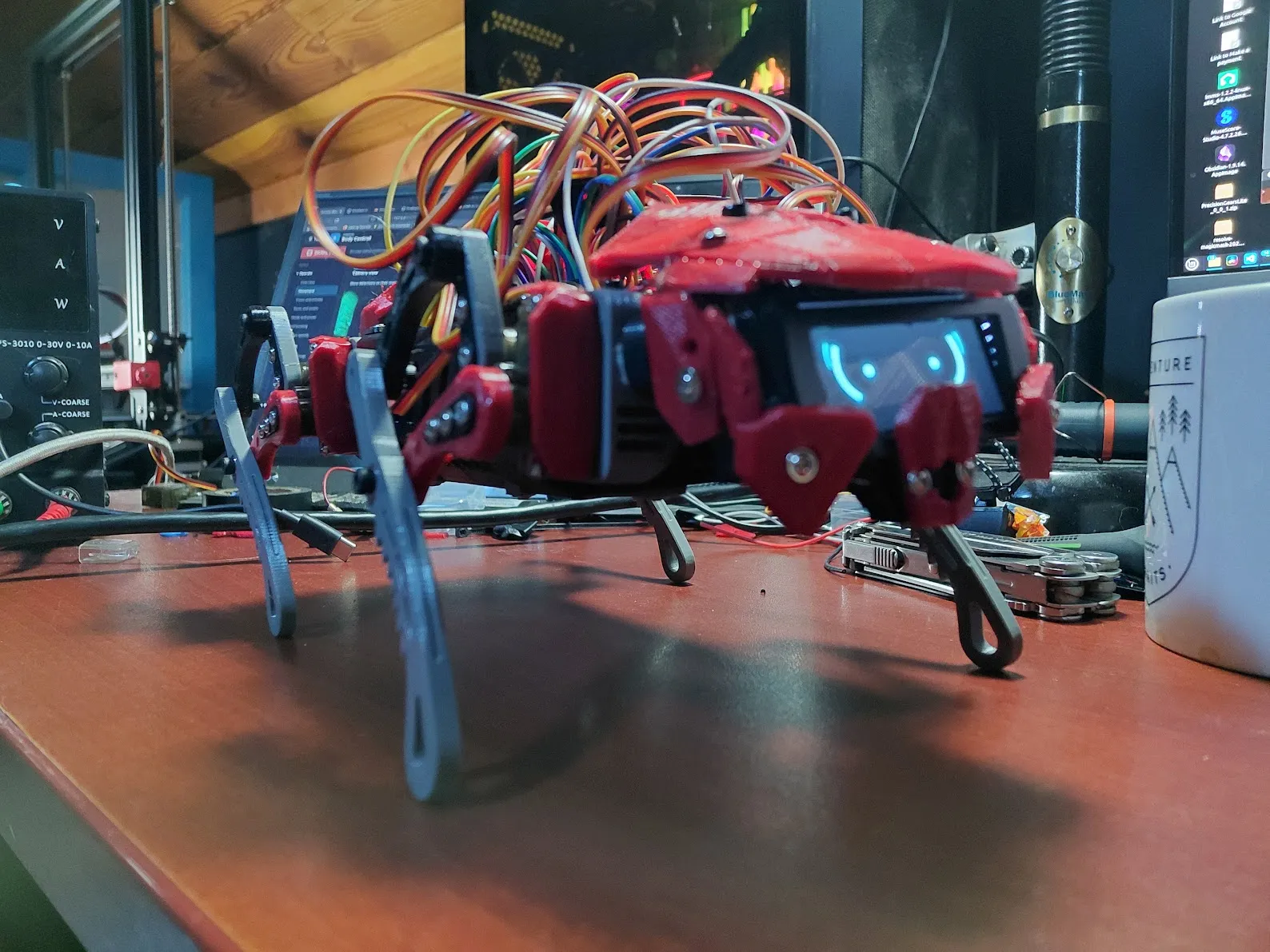
The images are not at the same scale. Both show physical prototypes, photographed on different dates; neither still image measures walking performance. Printed V2 leg prototypes are documented separately.
Mechanics and motion capability
| Comparison | V1 · eight servos | V2 · twelve servos |
|---|---|---|
| Actuators per leg | Two MG90S | Three Miuzei MG90S with added potentiometer-wiper feedback wires |
| Mechanism | Sesame-derived leg and open chassis | Shoulder roll plus coupled carrier/crank linkage; purpose-built supports, shell and underside |
| Foot placement | Primarily forward/backward and up/down | Adds sideways placement and variable stance width |
| Motion generation | Stored poses and timed sequences; 38 named assets | Freestyle-generated joint/foot/body targets, shared gait solver, and legacy library retained for manual control |
| Speed controls | Timing of existing sequences | Gait Speed or advanced stride/rate; separate named-motion multiplier; shared joint-speed limit can retime automatic motion while retaining the path |
| Turns | Stored 45°, 90° and 180° left/right clips; open-loop heading estimates | Continuous forward/turn updates during an admitted Walk; loaded steering remains to measure |
| Expressive movement | Wave, bow, dances and other prepared gestures | Prepared gestures plus generated movements; brisk lift and rear-sway corrections approved in individual October 25 trials |
| Balance and terrain | No measured adaptive balance result | Live IMU telemetry and configurable local leveling implemented; loaded correction and adaptive terrain response remain unqualified |
| Physical evidence | Working complete prototype; movement and audio demonstrated | October 25 supported Stand/Walk passed after a firmware stack repair; loaded chatter and reliable floor walking remain unresolved |
The V1 asset count is a finite library. A generated V2 program can combine targets, holds and face changes, with actual events requesting recovery. Counting named clips no longer describes its whole motion system.
Movement ranges: compare the quantities first
Dataset date: September 24. The numbers below are preserved for comparison; they have not been regenerated for the later controller revisions or the October 5–6 compact-linkage candidate. The latest motion entry compares that candidate with the shared model and records its changed poses.
A commanded angle is not a measured mechanical limit. V1 uses logical controller angles. V2 uses signed Blender angles for three coupled inputs. Their zeros, joint axes and mechanisms differ; subtracting the numbers does not give a meaningful percentage increase in reachable workspace.
| Range or movement | V1 | V2 |
|---|---|---|
| Software angle convention | Logical 0–180°; individual assets use subsets | Signed Blender angles for shoulder, carrier and crank, followed by per-joint calibration |
| Stored/sample envelope | Combined explicit targets span 0–180° across the eight channels | Shoulder −96.99 to +17.57°; carrier −79.02 to +135.37°; crank −128.11 to +101.29° |
| Walking data | V1 forward-walk targets use 45–90° excursions on individual channels; detailed table in the journal | September 24 sampled forward-walk recording: shoulder −4.47 to +4.25°, carrier −46.05 to +22.88°, crank −107.48 to +29.56° |
| Sideways travel | No dedicated third leg actuator; no measured lateral workspace supplied | Crab planner specifies 32 mm sideways travel per full-stride cycle |
| Foot travel in walking | No measured distance-per-cycle result in this review | 92 mm full planted sweep; nominal 131.43 mm advance per cycle at full stride |
| Whole-body usable limits | Installed stops, loaded workspace and travel measurements not supplied | Shoulder/body clearance, tracking, load and all-settings motion envelope remain unqualified |
The September 24 V2 envelope above was extracted from 23 declared gesture sources, 14 locomotion recordings and the Run recording, pooling all four legs by input type. It excludes the retired fixed-angle turn recordings. Its shoulder maximum therefore differs from older audits that included those turns. The forward-walk row includes its recorded Speed changes, advanced settings and Finish; it is not the extrema of every possible walking control setting.
Download the per-recording, per-joint CSV and its read-only extraction script. The CSV includes source hashes, preserves the two angle conventions and also lists all V1 explicit target ranges. The gait journal retains the original V1 channel table and earlier linkage studies.
The October 5–6 compact candidate
The shared model at 13fc3e4 and the offline candidate are distinct:
| Dimension | Shared model | Compact candidate |
|---|---|---|
| Carrier | 40 mm | 35 mm |
| Crank | 24 mm | 20 mm |
| Pickup radius | 24 mm | 28 mm |
| Connecting rod | 38 mm | 38 mm |
| Distal leg | 55 mm | 55 mm |
The candidate remaps all 23 named motions. Its selected Upright fit reaches 76.585 mm, compared with 90.339 mm in the baseline. Combined front-crank travel is 243.868°, exceeding the 225° span in the provisional servo mapping used by that study. Usable physical shaft travel remains unmeasured. These are pose/model comparisons, not approved mechanical limits. At the time of that study the candidate was separate. The October 26 working Blender assembly and geometry export now agree on 35 / 20 / 28 / 38 / 55 mm. The older pose values above remain results of their original study.
Earlier pulse-endpoint and assembly-mark studies retain their own dates in the gait journal. They should not be combined into a new calibration instruction without checking the actual installed assembly.
Controller and processing
| Comparison | V1 | V2 |
|---|---|---|
| Board | Freenove ESP32-S3-WROOM CAM, N16R8 | Waveshare ESP32-P4-WIFI6; tested P4 revision 1.3 |
| Main processor | Dual-core Xtensa LX7 | Dual-core high-performance RISC-V |
| Checked firmware clock | 160 MHz in local S3 configuration | 360 MHz in local P4 configuration |
| Flash / PSRAM | 16 MB / 8 MB | 32 MB / 32 MB |
| Wireless | S3’s own 2.4 GHz Wi-Fi | Separate ESP32-C6 coprocessor over SDIO |
| Servo signals | Eight direct hardware PWM outputs | PCA9685 driver for the twelve channels |
| Camera/audio hardware | OV3660 parallel camera; external microphone and I2S amplifier | Kit specifies OV5647 MIPI camera; onboard codec/audio path; installed peripheral operation needs its own evidence |
| Companion computer | MetaHuman OS on a separate computer | Q6A onboard for Wired or offboard for Wireless; QCS6490 eight-core CPU, Adreno 643 and Hexagon; audited unit has 11.288 GiB Linux-visible RAM |
| ROS 2 | No V1 integration in this review | Jazzy installed on Q6A; desktop messaging, recording and RViz checks recorded; robot adapter remains planned |
| Conversation and reasoning | MetaHuman OS on the host | MetaHuman OS remains separate from P4 motion deadlines; ROS does not replace it |
Processor families and board interfaces follow
Espressif’s S3 description
and the Waveshare board documentation.
Memory and clock values above also follow the local board records and checked
sdkconfig files. The S3 silicon supports up to 240 MHz; this checkout selects
160 MHz. These clock rates and memory capacities are not an application
benchmark or evidence of longer battery life.
The P4 solves the leg linkage directly and plays compact gesture curves through one output controller. The September 28 website’s deployment record reports a 2,370,848-byte application, verified flash and boots, retained twelve-joint calibration and saved motion speed after reboot. Hardware checks cover startup Home and settings; loaded twelve-servo timing, tracking and power remain separate measurements.
The Q6A figures come from the September 28 resource audit. More RAM and different processors allow different workloads, but their specifications are not a measured speedup over V1. Live IMU telemetry and saved leveling controls now have dated firmware installation records. Loaded leveling, the ROS adapter and native-USB body path remain unqualified. SD video and Wi-Fi maintenance are additional P4 features, with controller tests separated from loaded motion.
Power supply, battery, charging and running time
The separate-cell power arrangement is now identified in the October 26 hardware record. Earlier Anker and SHARGE bank plans remain historical iterations.
| Comparison | V1 | V2 · October 26 record |
|---|---|---|
| Battery | 1,000 mAh LiPo, owner-reported | 2S pack; 73.6 × 46 × 22 mm measured envelope; capacity not recorded |
| Voltage / energy record | Earlier parts record: 2S, 7.4 V; nominal 7.4 Wh by multiplication | October 15 report: 8.4 V battery; usable energy not measured |
| Conversion | External buck converter | Mini560; recorded 5 A rating, separate 5 V servo rail |
| Charging | External charger | Onboard HiLetgo 2S USB-C charger |
| Assembly mass | No comparable mass supplied | 650 g, owner report recorded October 26; earlier 566 g belongs to October 13 |
| Companion-computer power | Separate host | Selected offboard Q6A has its own supply |
| Running time | Not measured | Not measured |
| Loaded consumption | Not supplied | Current peaks, loaded voltage and average power remain to measure |
The revised V2 battery capacity is unspecified, so there is no current capacity-ratio comparison. A useful runtime estimate requires usable delivered energy in watt-hours and average whole-robot power: runtime in hours ≈ delivered Wh ÷ average W. Idle, walking and expressive motions need separately identified test conditions.
The September 24 Anker study and September 28 SHARGE budget preserve the earlier removable-bank iterations, including the proposed two-port 5 V / 3 A branch allocation. That allocation is historical, not a specification for the new batteries and charging boards. The October 6 rebuild records why the bank was dropped. The October 26 packaging record identifies the later pack, converter, charger and printed parts.
Sources and next comparison
The motion-range dataset and original V1 comparison use the local Ainekio
checkout after commit 3f872e7, including uncommitted September 24 work. The declared catalog, locomotion README,
CONTROLLER_VALIDATION.md, model geometry, V1 seed motions, hardware records
and both firmware configurations supplied the figures. The
source manifest records snapshot hashes.
The September 28 changes use robot commit 270537f, current controller
validation and saved Blender review notes, identified in the
September 28 source manifest. These are dated
source and validation records, not a new hardware test performed for the website.
The October 6 manifest adds robot
commit 13fc3e4, the later remote status change, local linkage research and
Blender review records. The physical standing result, new battery direction
and approximate improvement estimates come from Greg’s October 6 report.
The next comparison should add the completed assembly’s mass, physically measured foot workspace, loaded motion observations, delivered battery energy and timed runtime under stated gait settings.
October 8 update: current V2 physical observations and photograph come from the owner. See the new build entry and source manifest. Earlier range datasets and improvement estimates retain their original evidence boundaries.
October 12: shell/power and motion revisions, YOLOE and trained MetaHuman specialists extend this record. Model timings are desktop evidence, not a V1/V2 or Q6A hardware benchmark.
Ainekio V1 and V2: Eight Servos Versus Twelve
https://ainek.io/posts/v1-v2-comparison/