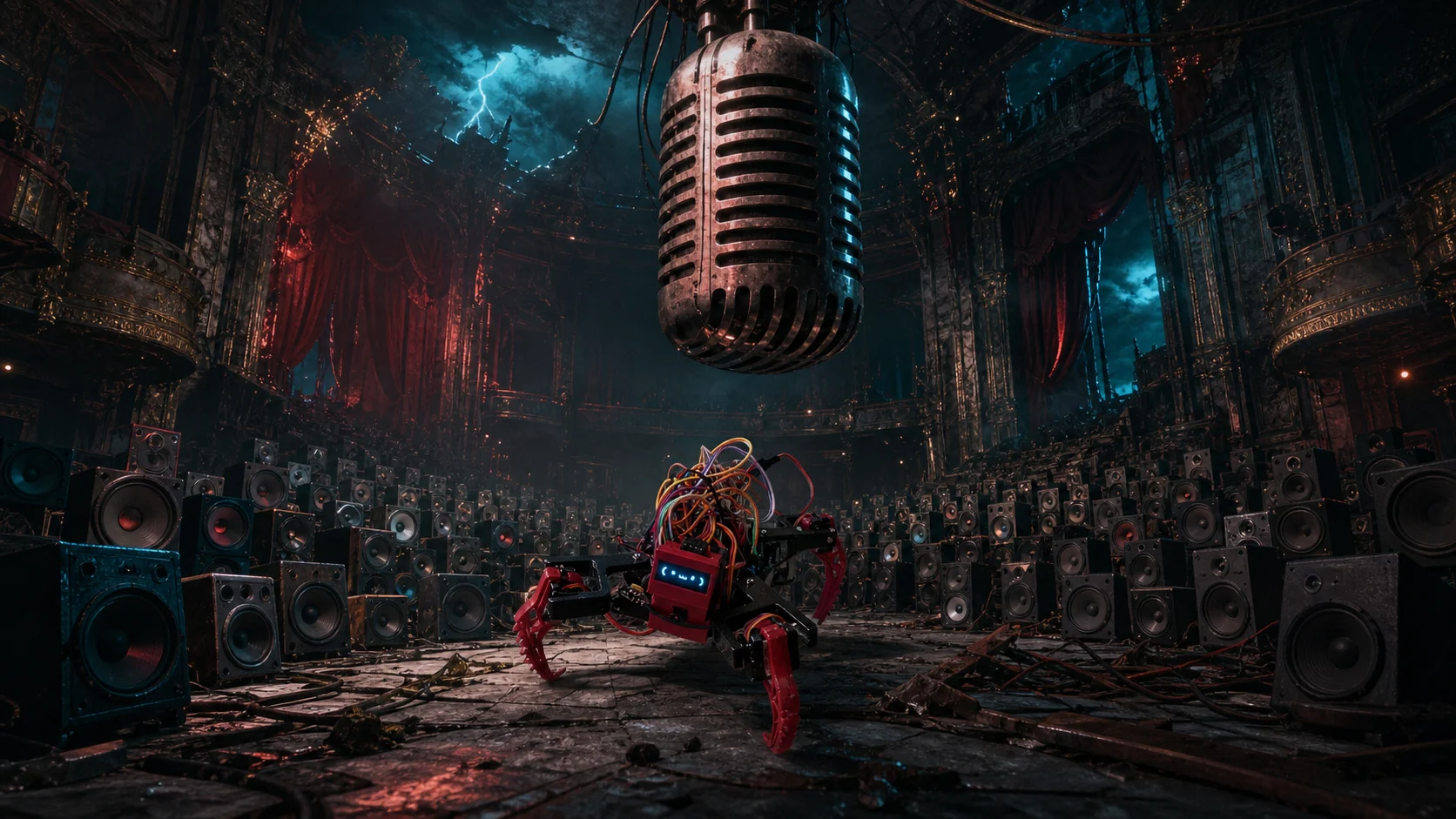
One conversation, two physical directions
Voice crosses the Ainekio and MetaHuman boundary in both directions. Listening begins on the robot and ends in MetaHuman’s conversation path. Speaking begins with MetaHuman synthesis and ends at the robot’s I2S speaker.
The implementation is substantial, but “the microphone code exists” and “the robot can hold a reliable room conversation” are still different claims.
Listening path
digital microphone
  -> ESP32-S3 I2S capture at 16 kHz mono
  -> local wake gate and neural VAD
  -> 20 ms PCM frames
  -> Ainekio gateway utterance assembly
  -> bounded WAV envelope
  -> MetaHuman Environment Bridge
  -> Whisper transcription
  -> audio_utterance Environment observation
  -> canonical conversation admission
Each microphone PCM frame is 640 bytes: 20 milliseconds of 16-bit mono audio at 16 kHz. The gateway does not ask Whisper to transcribe every frame. It assembles one bounded utterance around wake/VAD events, then sends one audio envelope.
The controller uses a pinned neural VAD model with a minimum capture window, a silence closing window, and an absolute maximum. Its outgoing queue uses PSRAM to absorb short WebSocket stalls without making the microphone an unbounded memory source.
Wake-word ownership
The robot contains a real microWakeWord/TensorFlow Lite Micro runtime. It loads
an owner-trained package from LittleFS and verifies the manifest, tensor shape,
frontend, and model identifier before reporting wake_ready=true.
No accepted production Ainekio model is tracked. The safe seed therefore starts with wake disabled and not ready.
A pilot model has been exercised on the physical path, and its real-room false triggers exposed an important problem: the staged cutoff was much lower than the documented packaging default, and the negative test set was too small. A small threshold sweep was a tuning clue, not production proof.
The production gate needs hours of negatives from the actual room, including robot-speaker output, servo noise, television, fans, and similar speech. It also needs confidence/rearm evidence from the installed controller.
Audio and image correlation
When VAD closes an utterance, the robot can capture a still with the same origin identifier. Environment Bridge can then join the completed utterance with the fresh image before admission. This provides much better context than an old uncorrelated camera cache.
The frame is optional when the camera is unavailable. Audio capture should fail or proceed according to its own contract rather than fabricate visual context.
Speaking path
MetaHuman response
  -> Kokoro or configured synthesis owner
  -> bounded PCM speech artifact
  -> Environment Bridge speech transport
  -> Ainekio Environment adapter
  -> gateway paced TTS burst
  -> protocol speaker PCM frames
  -> ESP32-S3 audio queue
  -> I2S amplifier and speaker
  -> correlated terminal playback result
The current bridge source carries one bounded PCM artifact with session and action identifiers. The Ainekio adapter sends it through the gateway, waits for the robot terminal result, and reports completed, cancelled, rejected, or timed out feedback to the original speech action.
This is stronger than assuming a conversational sendText acknowledgement means
the physical speaker played anything.
Physical speaker evidence
The firmware accepts speaker PCM only inside an active TTS burst. It queues the frames and sends them through the external I2S amplifier. Queue overflow, interruption, orphan data, and terminal completion are explicit conditions.
Field testing produced clean audible playback after adding a bounded prebuffer and pacing small blocks relative to actual send time. The same run still showed speaker underruns and independent microphone transport faults. Subjective audio quality and health counters therefore remain separate results.
Half duplex and motion feedback
Full acoustic echo cancellation is not part of the current physical path. The system uses deliberate microphone suspension and cooldown while the robot is speaking.
Small listening and speaking motion cues exist, but they are subordinate to motion, calibration, stop, sleep, fail-safe, and power readiness. USB-only controller bring-up correctly suppresses servo feedback that requires a healthy battery path.
Next voice acceptance
The useful next test is a repeated physical conversation with one evidence trace:
- wake probability and rearm behavior;
- VAD open/close and PCM-drop counters;
- correlated utterance and optional frame;
- Whisper transcript and conversation admission;
- generated response and speech artifact;
- gateway speaker sequence;
- robot terminal playback result;
- underrun, reconnect, and microphone-resume counters.
Passing that sequence repeatedly in the real room is the threshold for calling the voice loop reliable.