Ainekio
Build journal
Build history by topic
Original eight-servo journal →Latest entries
Legs & gait · V2 · 12 servos
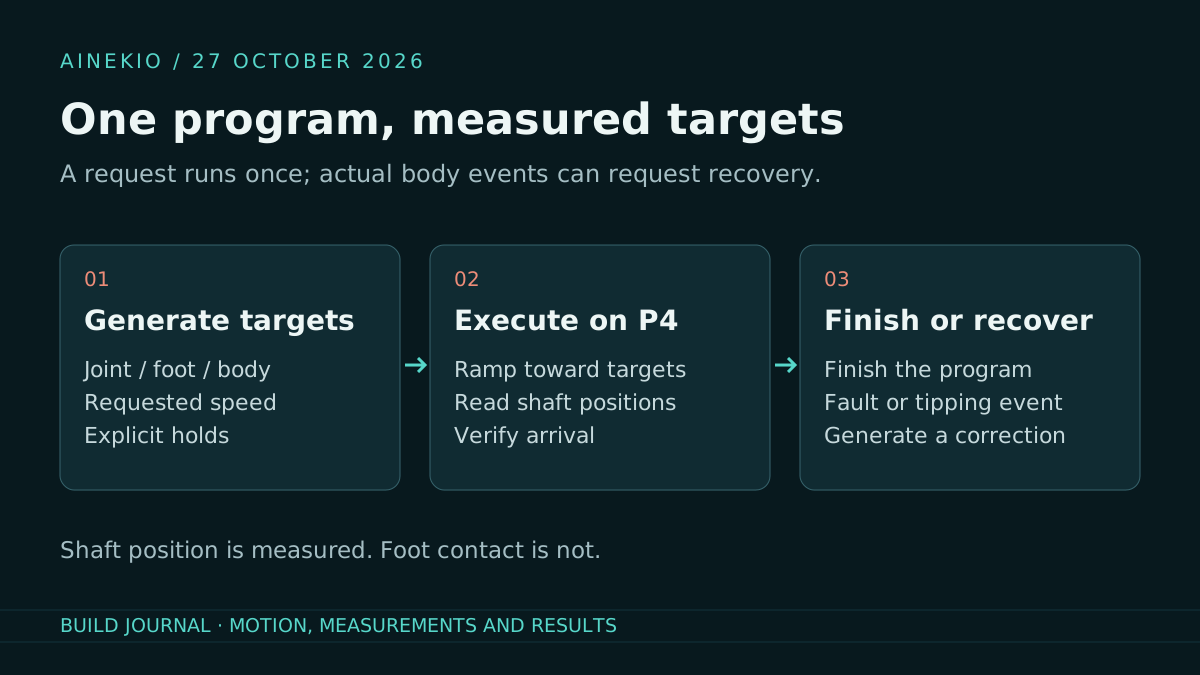
Freestyle runs once: finite motion, recovery and a supported stretch
A new finite-event model replaces the continuation loop. Simulated event corrections finish; a separate supported stretch passes physical review, while generic calibration and real recovery remain open.
Freestyle model, feedback and physical review
339 training examples · 40/62 reference matches · nine verified targets
Legs & gait · V2 · 12 servos
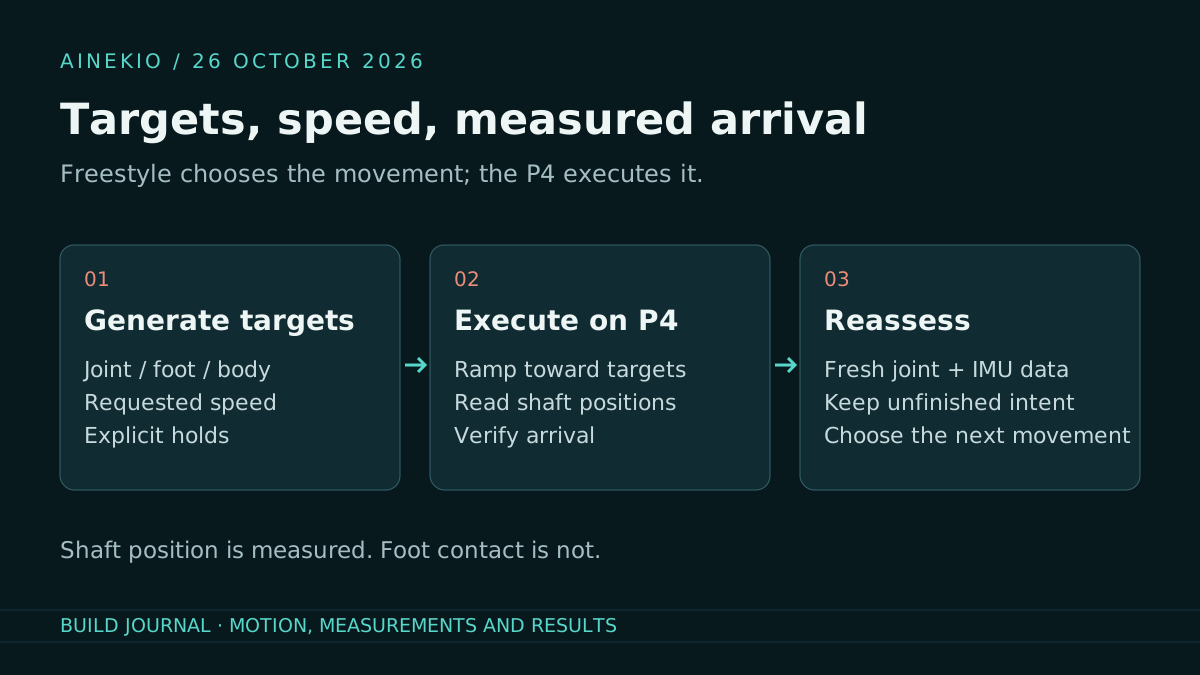
Freestyle: teaching targets, speed and recovery
Compact motion programs, measured shaft arrival and reviewed gesture corrections lead into a 1,261-example Stand training run. Reference agreement improves, but acquiring Stand and finishing compound movements remain difficult.
Motion model, Body Control and P4
Editable library · Q6A inference · Stand continuation
Chassis, shell & power · V2 · 12 servos
650 g, revised power packaging and a training stand
Current mass, power components, linkage dimensions and support-stand files, alongside the supported Stand/Walk trials and fresh-feedback arrival changes.
Blender, printed parts and firmware
2S battery · Mini560 · three-part stand exports
MetaHuman OS · V2 · 12 servos
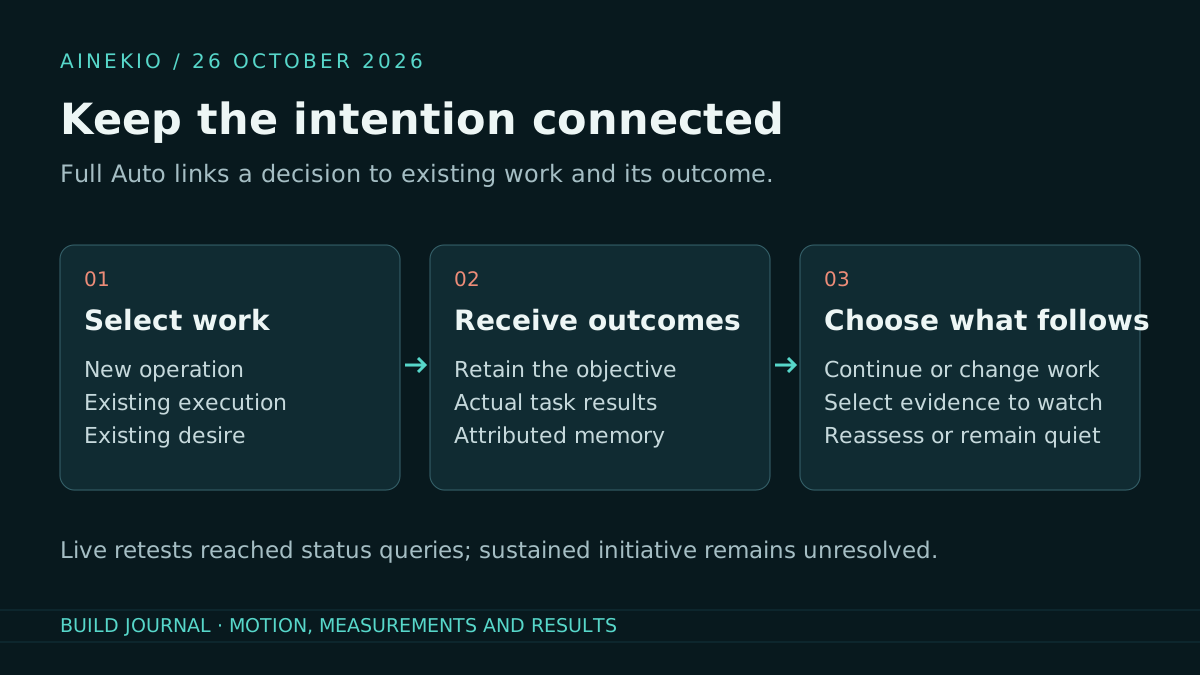
MetaHuman: keeping an intention through its results
Full Auto can continue recorded work and use its outcomes. Live testing exposes the remaining initiative gap; queue, event publication and on-demand model changes improve the supporting runtime.
Full Auto, Environment Bridge and execution
Existing goals · attributed memory · live initiative tests
Legs & gait · V2 · 12 servos
Learning from real walking: trials, feedback and a live training loop
Physical trials demonstrate modest tracking gains, followed by a host learning loop that records normal walking and compares candidates. Camera estimates, transport gaps and unresolved locomotion quality remain explicit.
P4 motion and Body Control learning
Loaded comparisons · separate Walk / Run policies · learning history
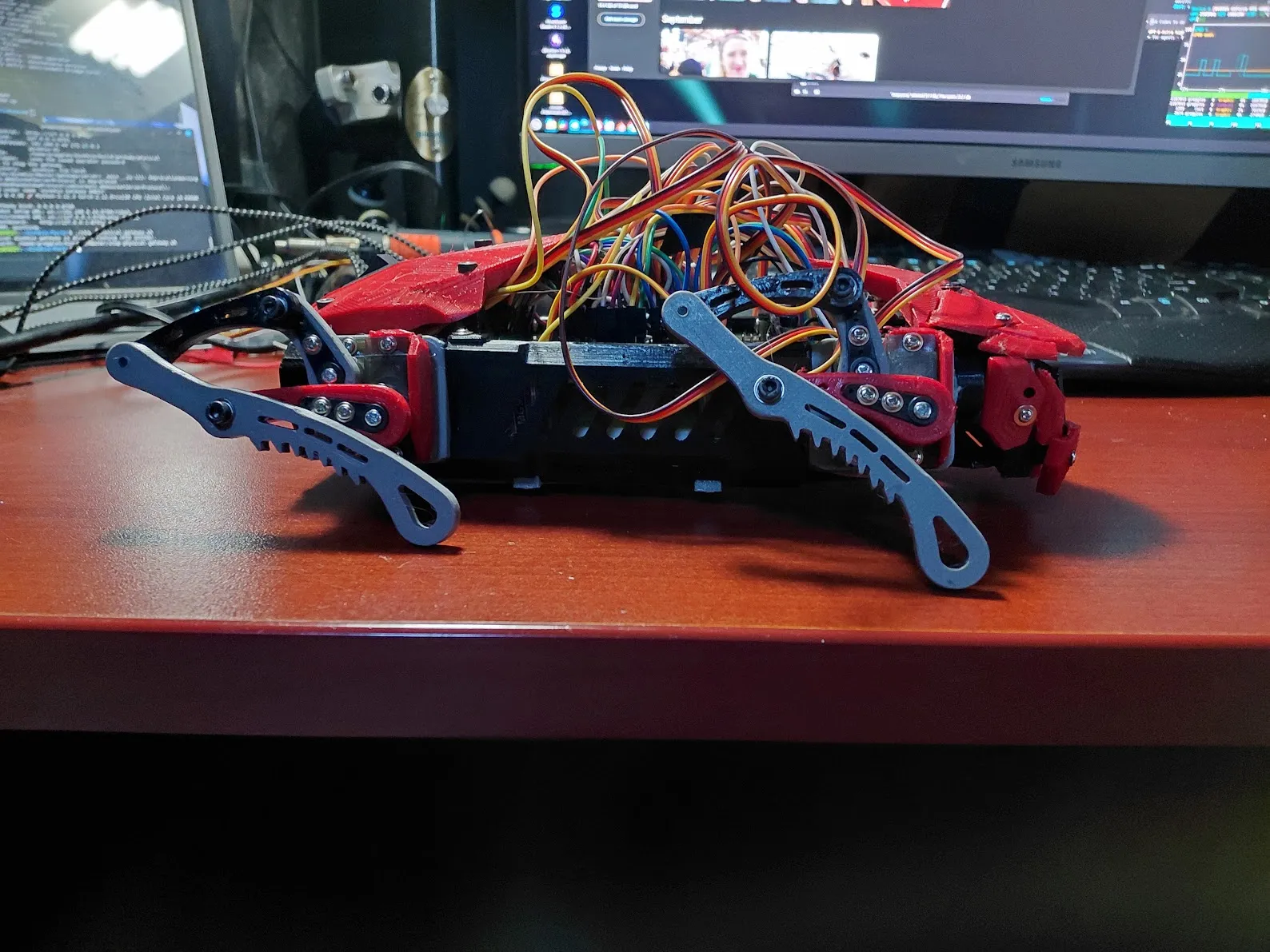
Chassis, shell & power · V2 · 12 servos
The rebuilt body: a new face, measured standing and powered continuity
A repaired ground connection restores useful joint feedback and steady measured standing in one trial. New face geometry, final-pass verification and connection-loss handling accompany the rebuilt body; inactivity rest is prepared.
Physical assembly, P4 and Body Control
October 21 photos · ground-repair retest · installed 0.8.113
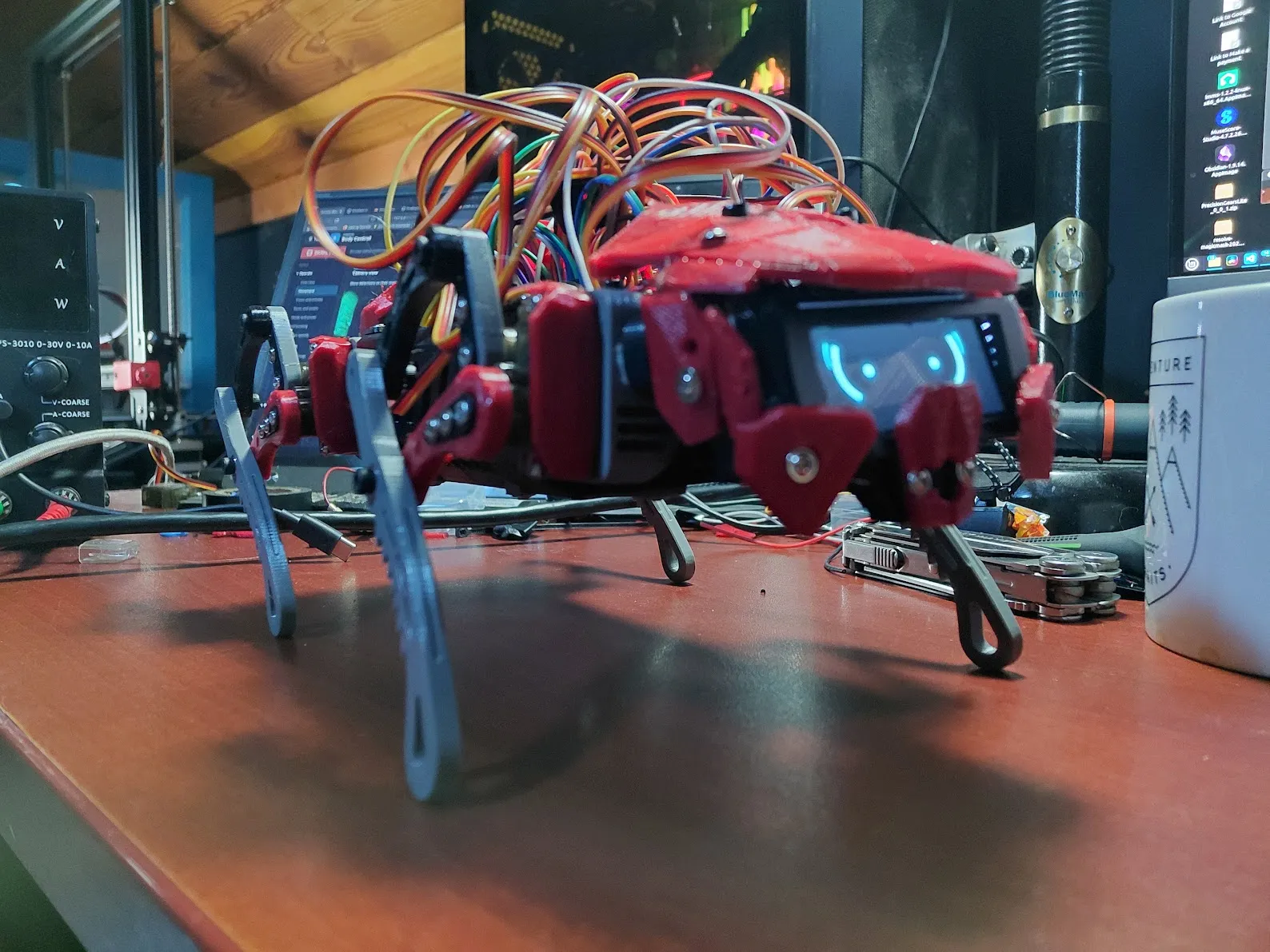
MetaHuman OS · V2 · 12 servos
Faster body reactions and cleaner recovery in MetaHuman OS
A dedicated tip/shake workflow shortens reaction planning. Activated lifecycle and transport repairs finish admitted event work and preserve it across reconnect, while new offline input is not queued for later delivery.
MetaHuman workflows and Environment Bridge
One Lightweight call · motion-aware events · durable receipts
Chassis, shell & power · V2 · 12 servos
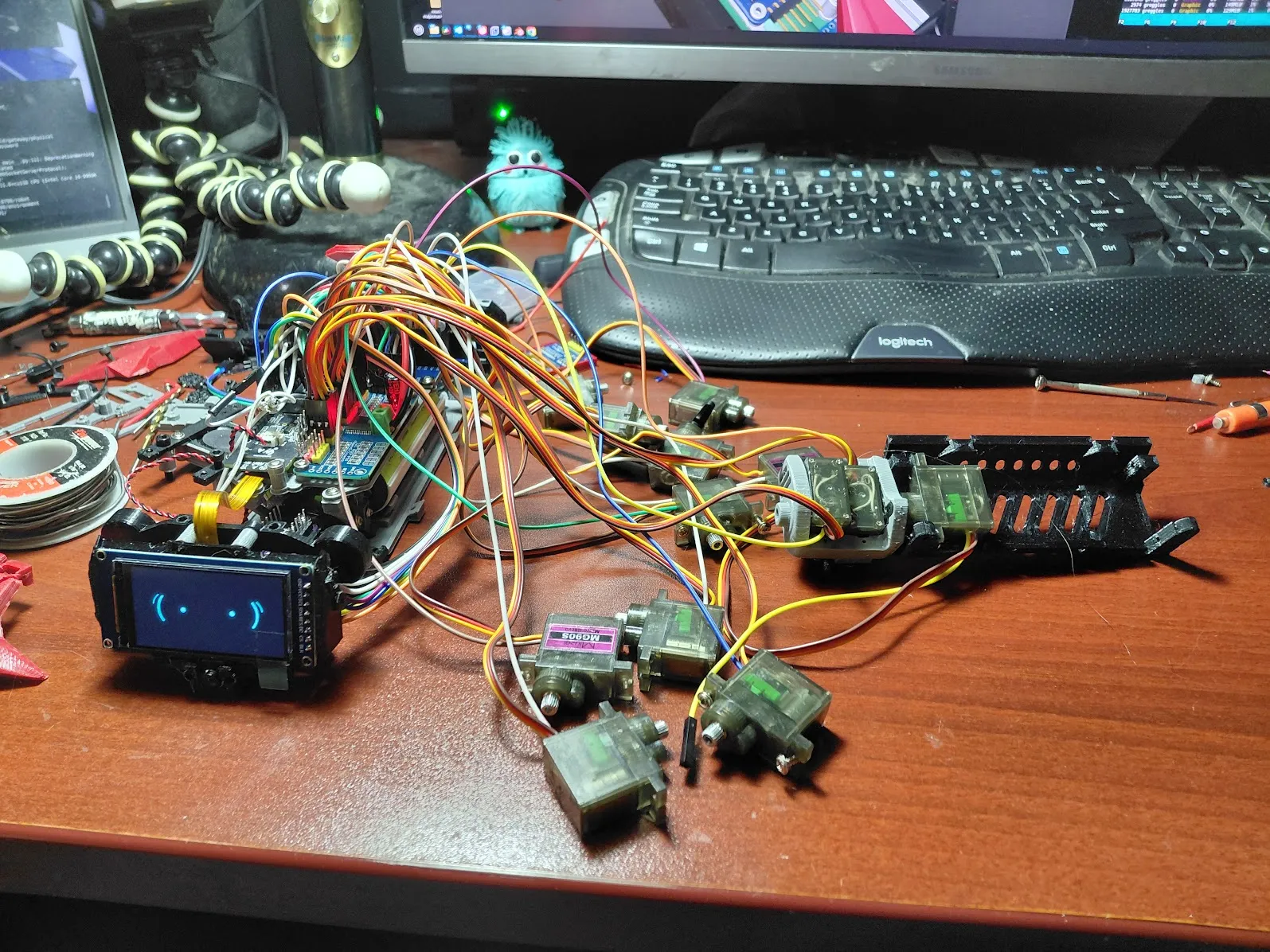
Listening to the servos: feedback wiring and a rebuilt chassis
Fourth-wire servo readings now reach the P4 through a CD74HC4067 multiplexer. All twelve loose servos are calibrated; revised chassis parts accompany the rebuild. Loaded standing and walking remain to qualify.
V2 / P4 and Body Control
Twelve calibrated channels · revised mounts · real build photographs
MetaHuman OS · V1 + V2
MetaHuman update: trained 2B specialists and clearer task outcomes
New trained specialists, a separate autonomy adapter and activated execution repairs accompany camera and memory tests. The report separates deployed changes from remaining decision, recall and physical qualification work.
MetaHuman models, execution and memory
2B Intent / Task · experimental 9B autonomy · monitor repair
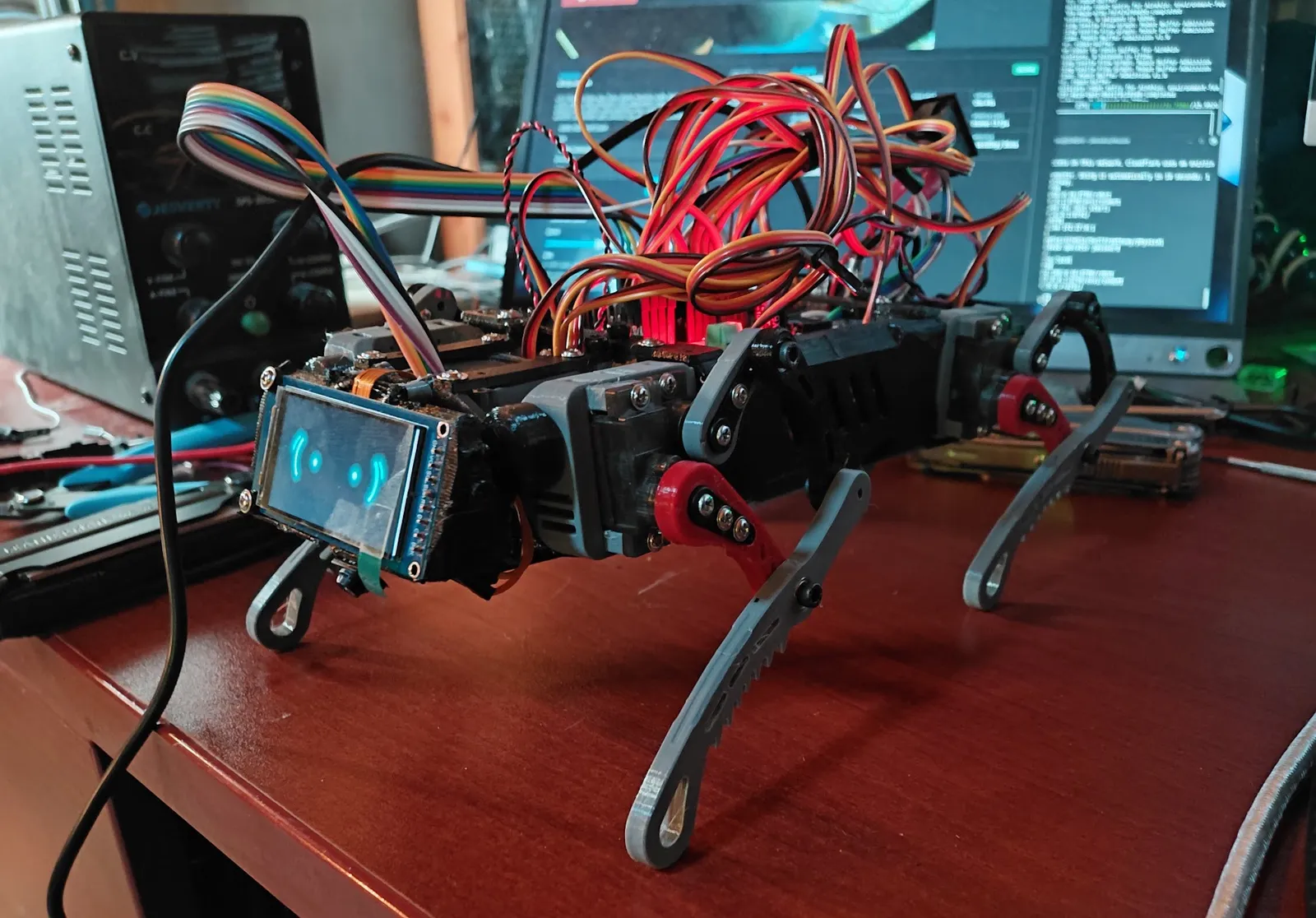
MetaHuman OS · V1 + V2
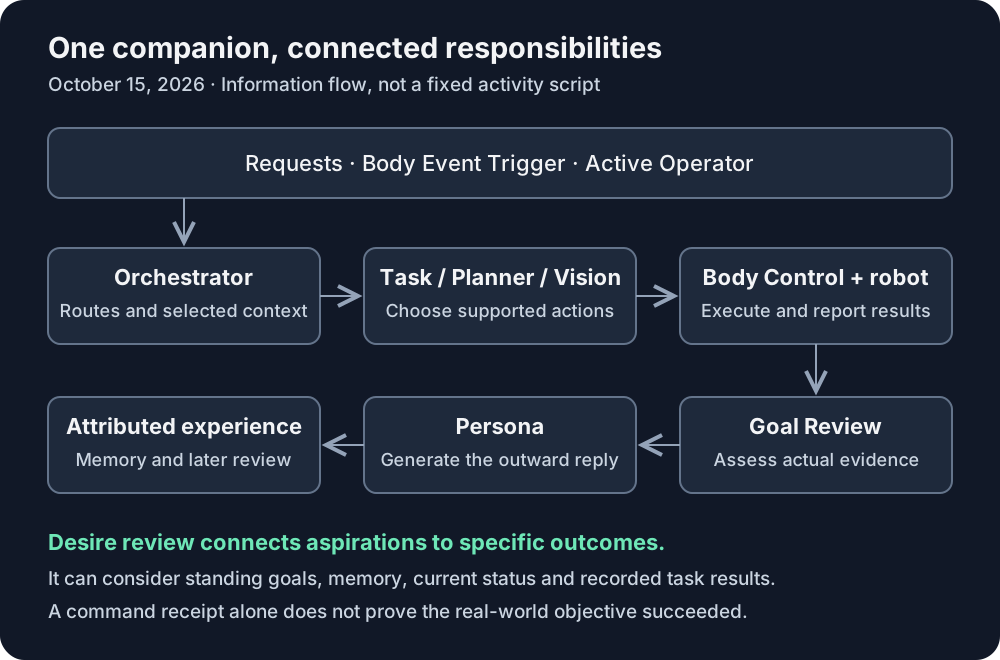
A more connected companion: agency, memory and one voice
Persona becomes the outward speech owner. Desire review gains standing goals, memory provenance and task results; workflow recovery retains events and admitted graph definitions. Grounded companion behavior remains under qualification.
MetaHuman OS and Agency
Active Operator · shared model categories · attributed evidence
Firmware & connections · V2 · 12 servos
Giving movement a goal and evidence of arrival
Selected locomotion goals now connect to measurement and Finish evidence. Signed lateral control has an installation record; camera calibration, model qualification and physical arrival accuracy remain open.
MetaHuman Active Task, Bridge and P4
Distance / turn / approach / follow / visual goals · lateral control
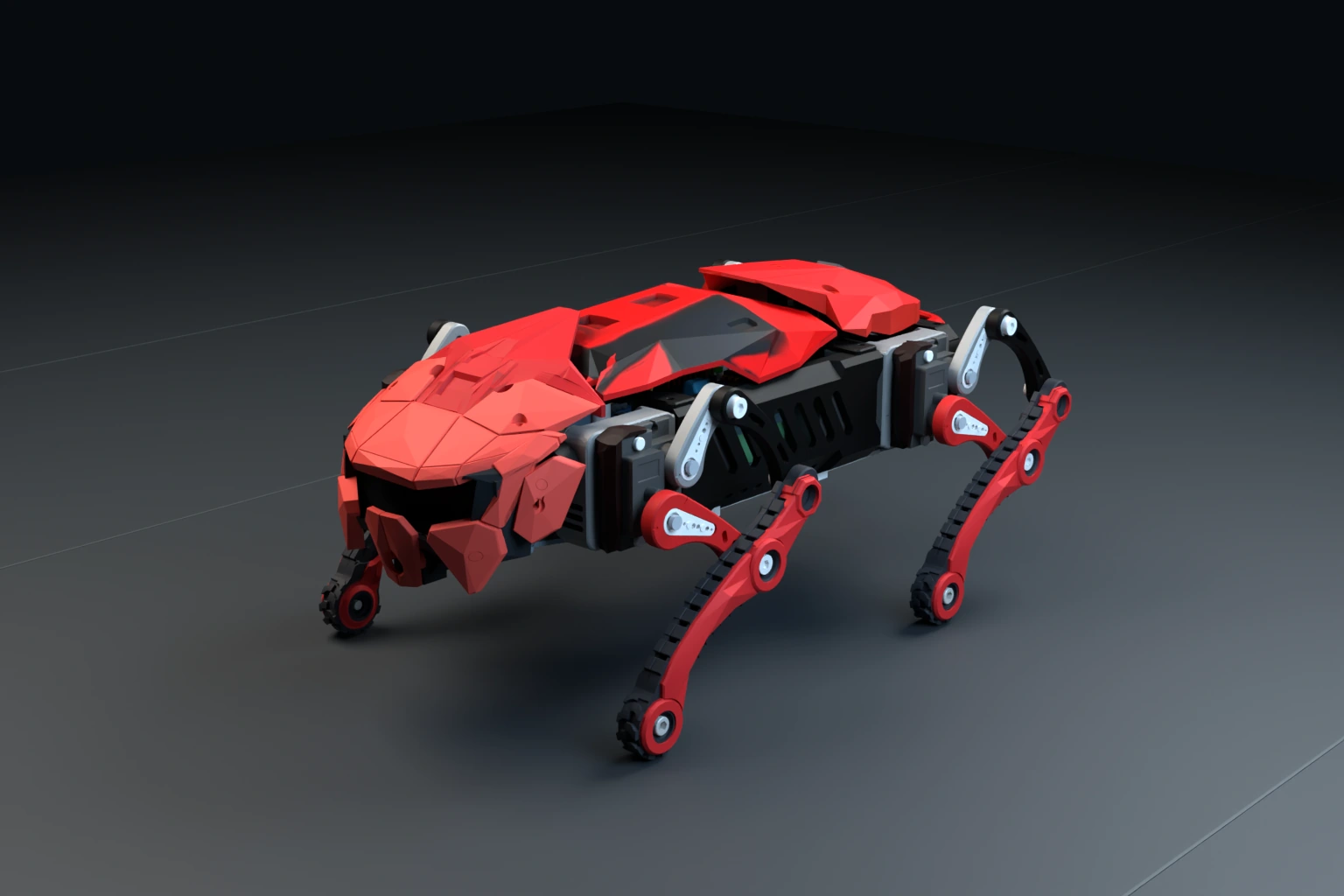
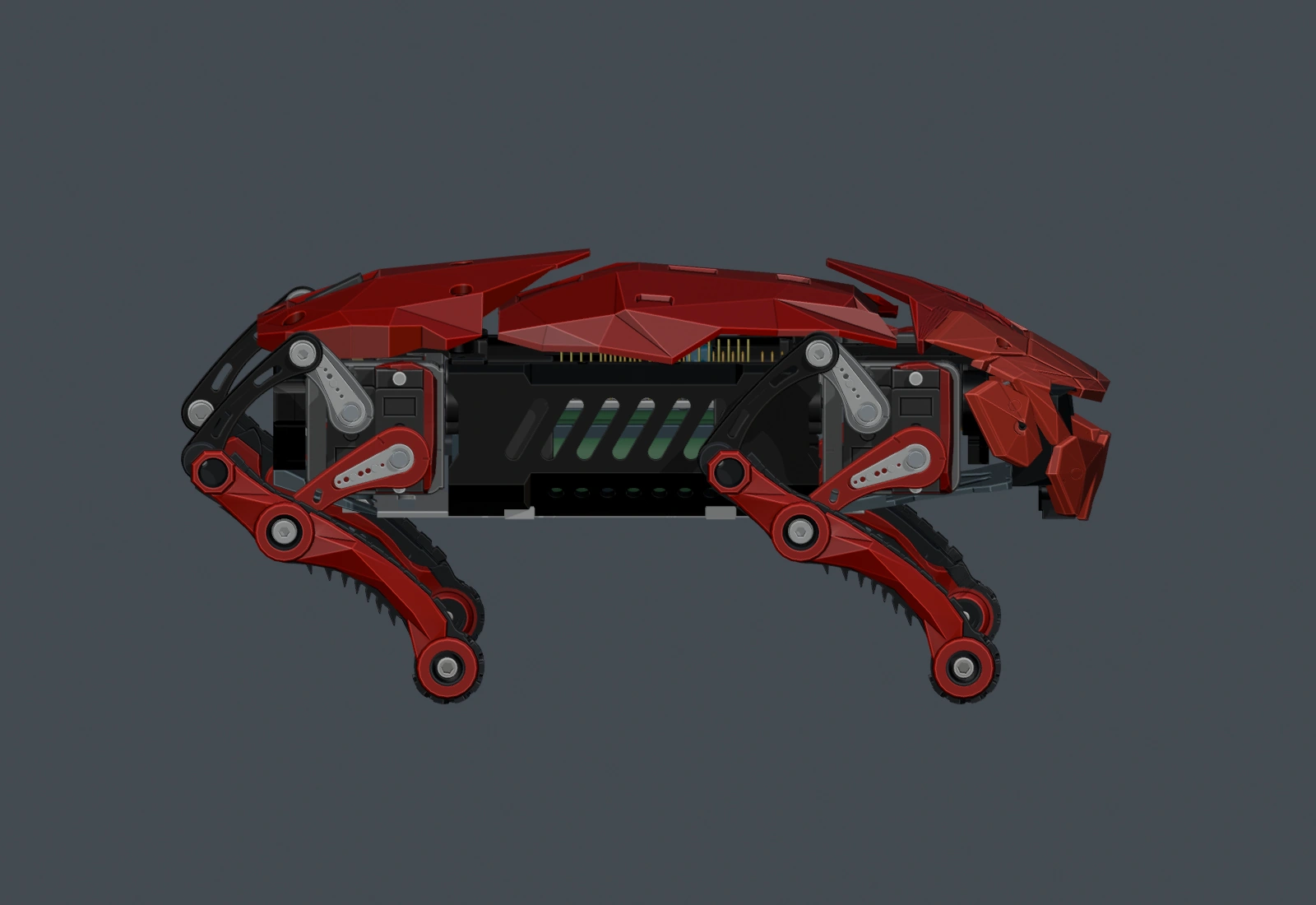
Legs & gait · V2 · 12 servos
More expressive motion and clearer self-leveling controls
Longer commanded steps, revised bare-leg contact paths, staggered servo pulses and a quicker Wave accompany level-reference and per-leg diagnostics. Firmware installation through 0.8.52 is recorded; loaded performance remains unverified.
V2 / P4 and Body Control
Revised Walk / Run / Crawl / Crab · seated Wave · gyro tools
MetaHuman OS · V1 + V2
Testing 9B learning for autonomy and personality
Small autonomy and persona fits completed, but actual serving tests retained objective loss and invented experiences. The production setup was restored; revised Task references now follow the single Persona speech contract.
Remote training and local serving comparisons
Two independent diagnostic adapters · no production promotion
MetaHuman OS · V2 · 12 servos
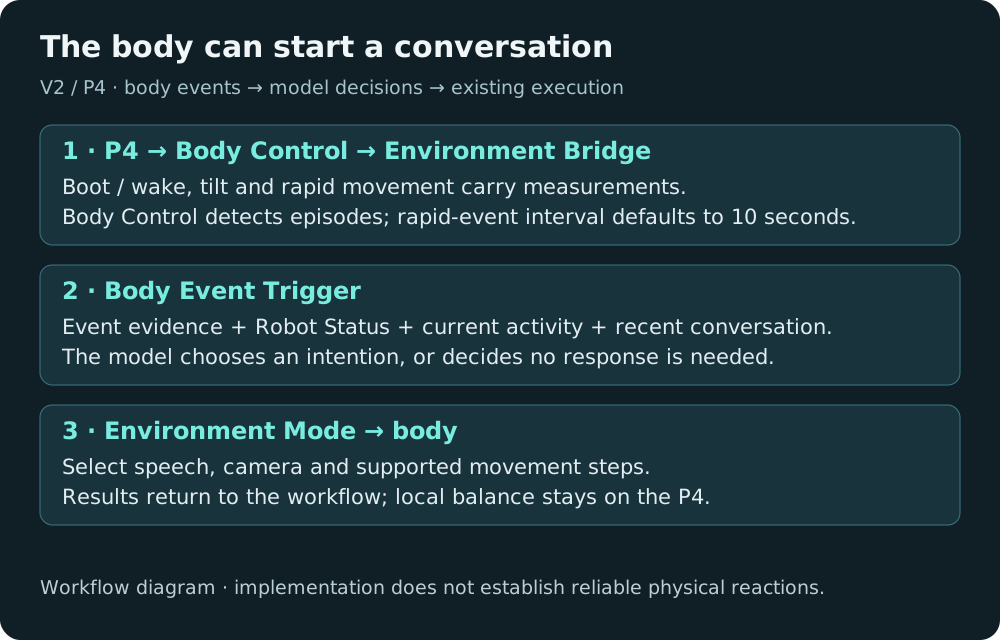
The body can start a conversation
A dedicated Event Trigger workflow receives body measurements and selects an intention for Environment Mode. Robot Status includes IMU evidence; reaction wording comes from the model. Full wake/stretch reliability remains open.
Body Control and MetaHuman OS
Wake / tipped / rapid movement · configurable reporting
Legs & gait · V2 · 12 servos
Startup, self-leveling and the real leg geometry
Boot posture is separate from calibration Home. Body Control gains saved leveling strength, damping and attitude targets; the geometry calculator explores load and reach. Installation is recorded, with loaded correction still unverified.
P4 body controller and linkage research
Staged rise · saved tuning · 566 g / 5 V report
Firmware & connections · V2 · 12 servos
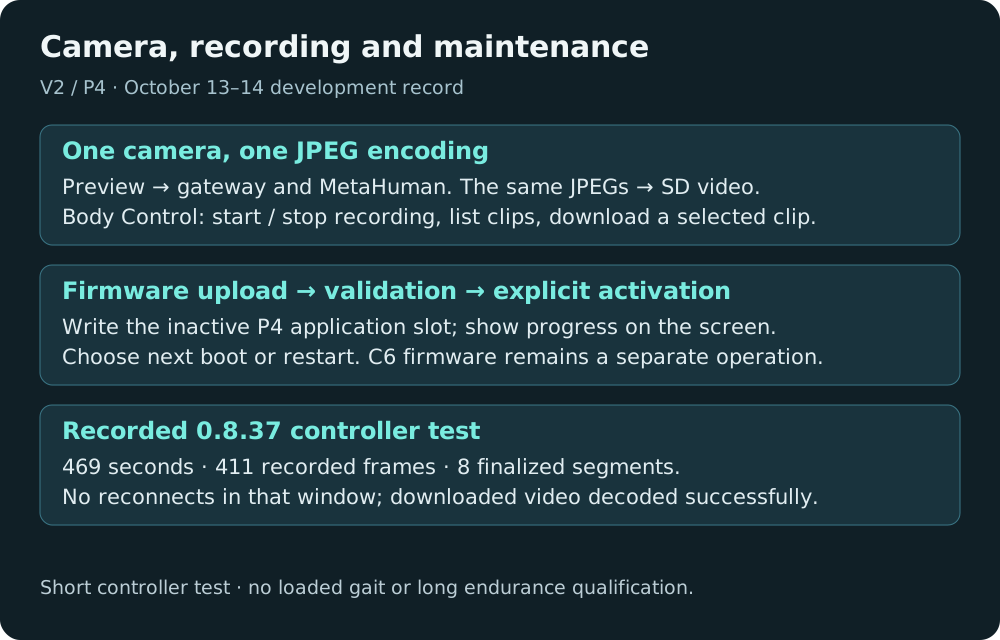
Video on the robot, firmware updates over Wi-Fi
Shared JPEGs feed internal-card video; Body Control retrieves clips and logs and stages P4 updates for explicit activation. A 469-second controller run recorded 411 frames without reconnecting.
P4 camera, SD storage and Body Control
Record / download · staged OTA · robot logs
MetaHuman OS · V1 + V2
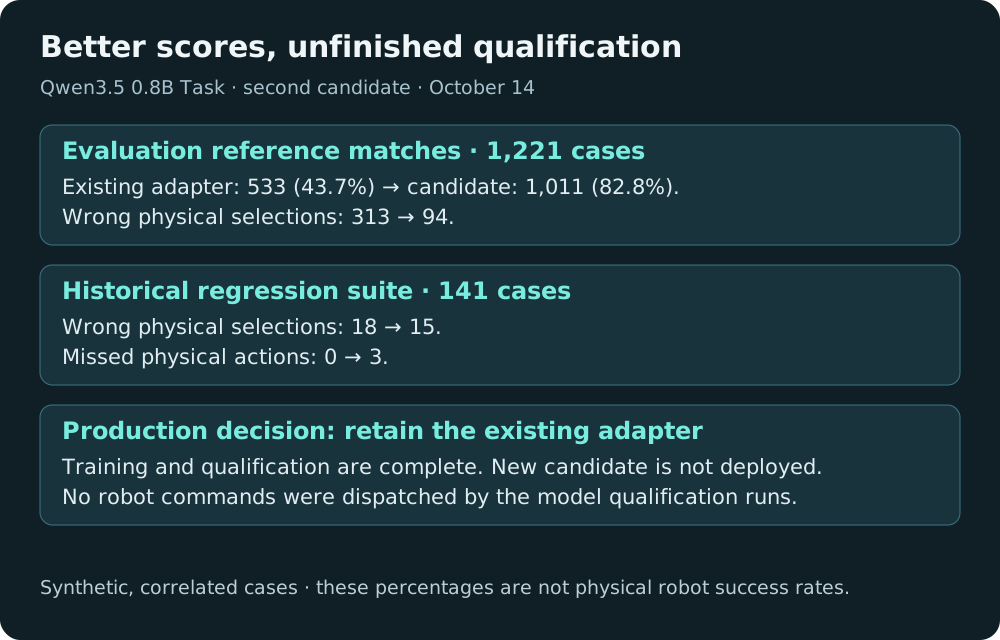
Teaching the Task model what to say and what to move
Training addresses quoted speech mistaken for physical movement. The latest candidate improves overall reference agreement but misses three historical actions; the existing Task adapter remains in production.
MetaHuman specialist training
Two 0.8B candidates · held-out comparison · no deployment
Chassis, shell & power · V2 · 12 servos
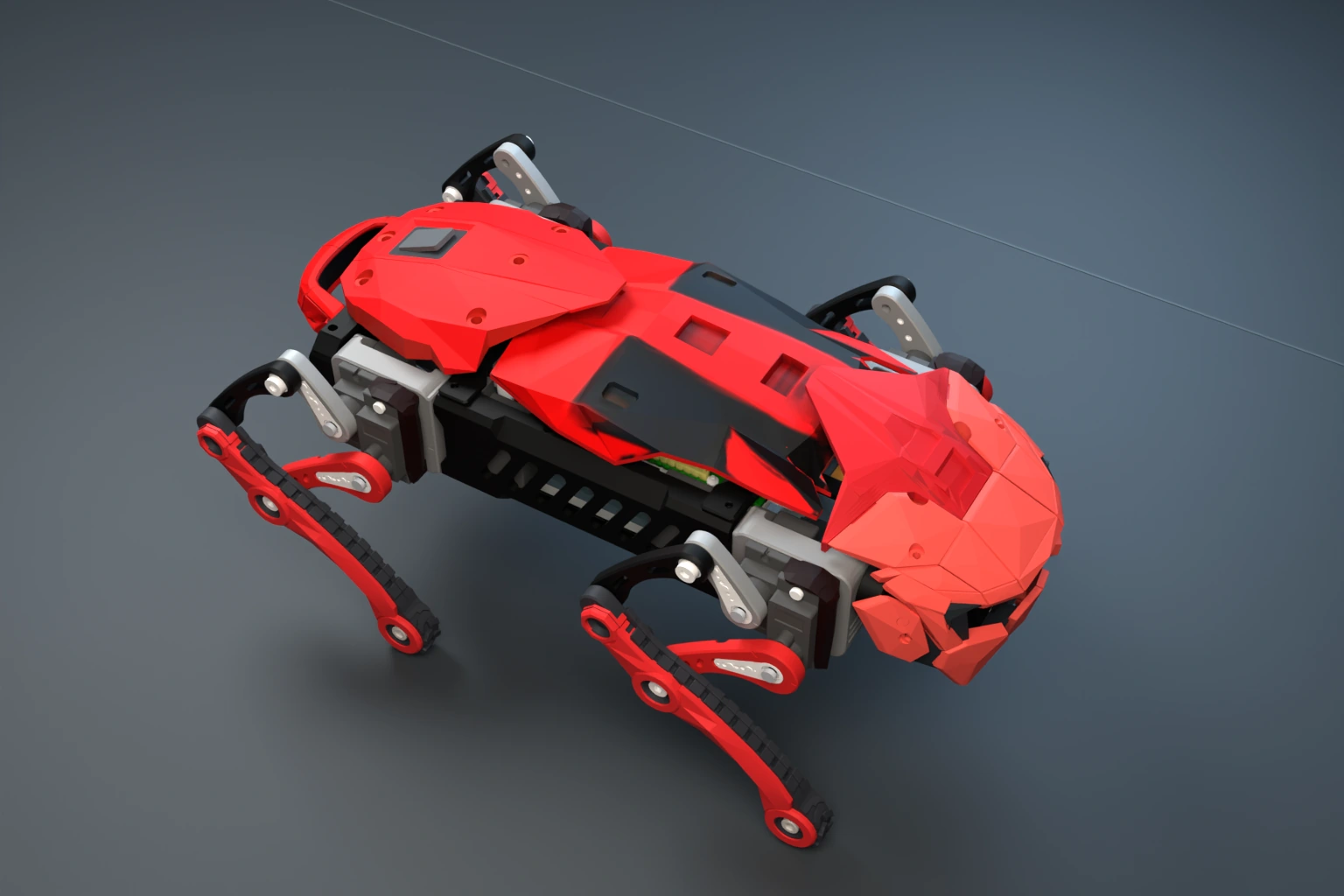
Shell printing, weight changes and a 4 A supply
Exterior printing has begun, with more weight modifications and a switch to a 4 A supply. See the current Blender design, explore dated shell and camera-mount files, and compare revised Lay Down and Play Dead paths.
Physical build and Blender development
Exterior printing · prototype exports · revised grounded motions
Vision, face & voice · V2 · 12 servos
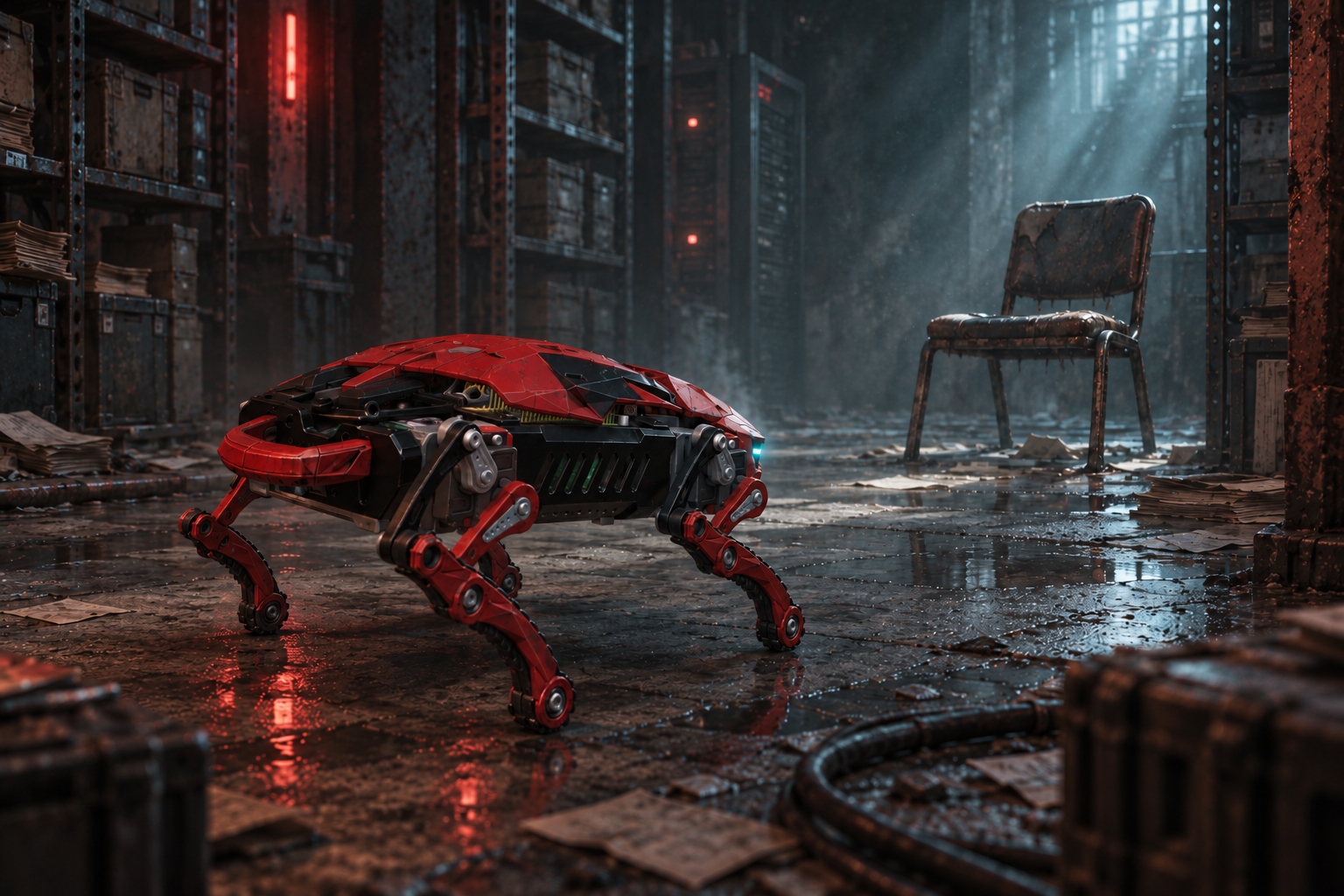
YOLOE: from person detection to selected targets
Real camera observations now reach MetaHuman with query and track IDs. The stationary chair test shows both a weak model-selected region and a successful tighter reference, with sustained camera recovery still unresolved.
P4 camera, desktop gateway and MetaHuman
Search / select / release · ByteTrack · live chair test
MetaHuman OS · V1 + V2
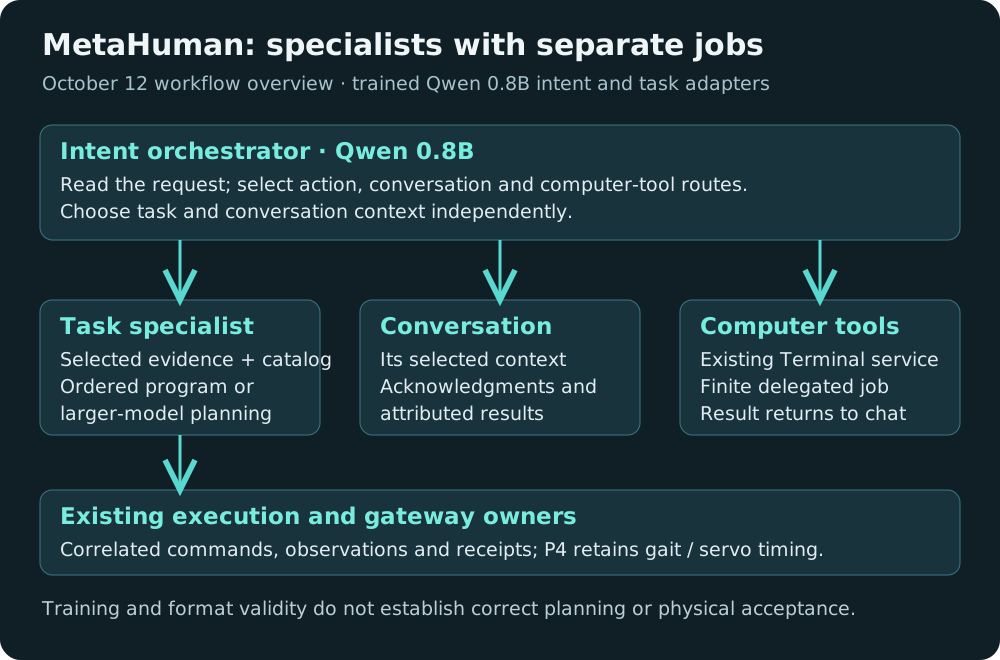
Training the intent orchestrator and task manager
Follow the trained intent/task split, recorded activations and computer-task delegation. Side-by-side results explain why a later goal-planning candidate was rejected despite a better evaluation score.
MetaHuman OS models and node workflows
Qwen 0.8B specialists · tool routing · paired candidate results
Legs & gait · V1 + V2
Gait journal: lift, place, then lower
Lay Down and Play Dead gain staged foot placements and a reverse recovery path in local source. The journal preserves the original end poses and distinguishes sampled geometry from physical qualification.
Continuing motion experiments
8 mm authored lift · seven-second clips · modeled speed comparison
Legs & gait · V2 · 12 servos
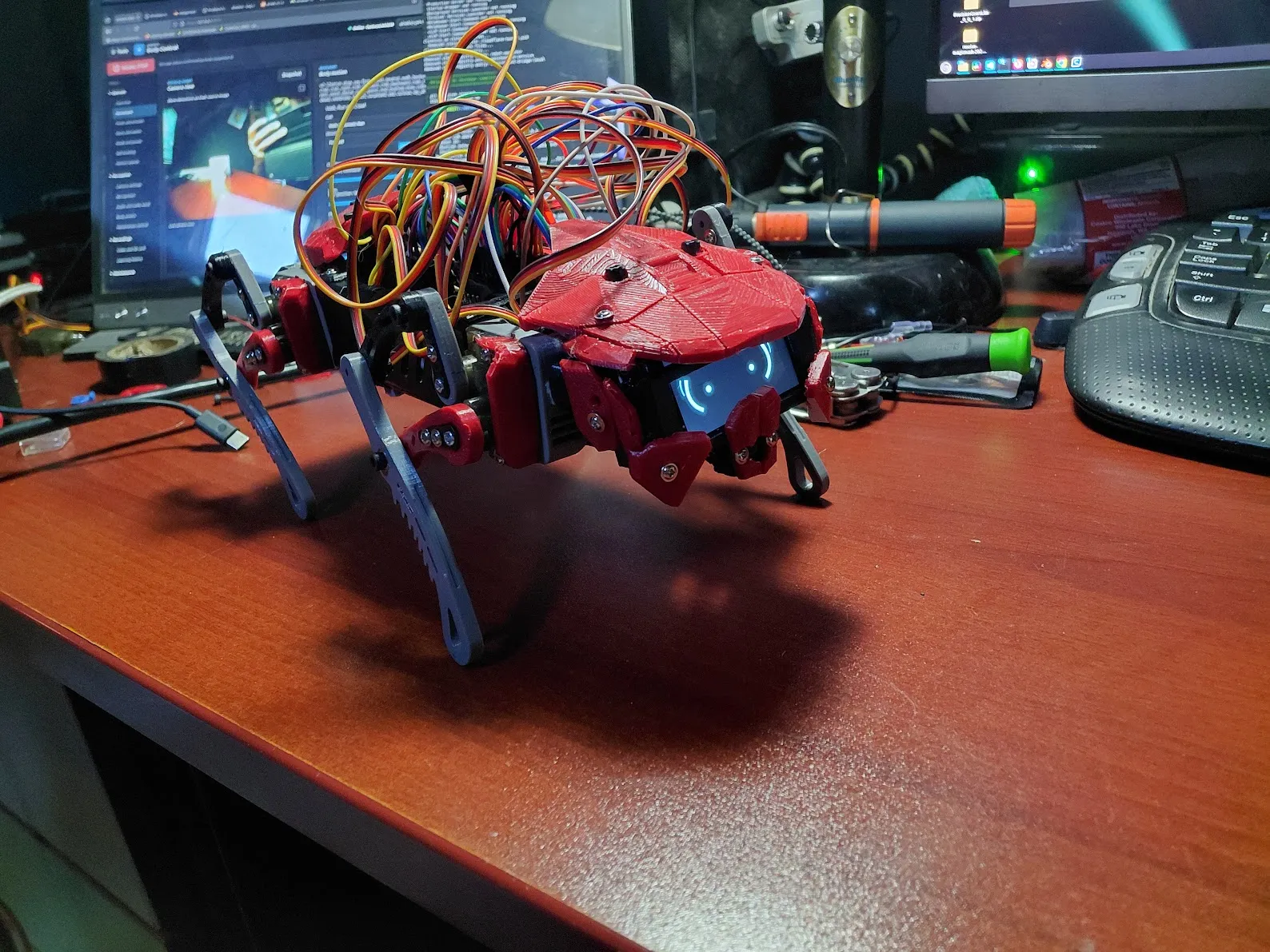
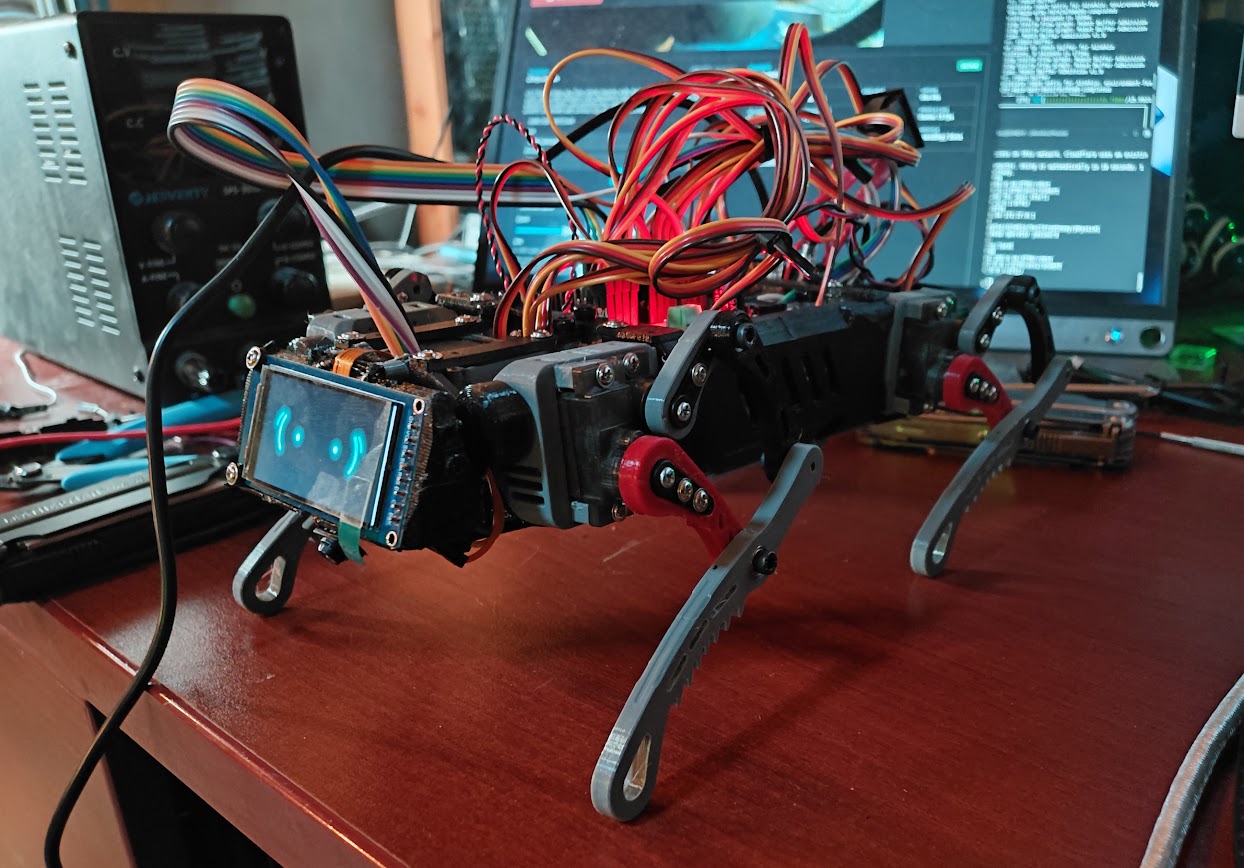
Standing, walking and responding to commands
The robot can now stand, walk and respond to commands. The exposed assembly, October 6 comparison, and latest mounting-part exports. Active Operator has not been tested.
Physical twelve-servo robot
Owner report · new photograph · carapace still off
Vision, face & voice · V2 · 12 servos
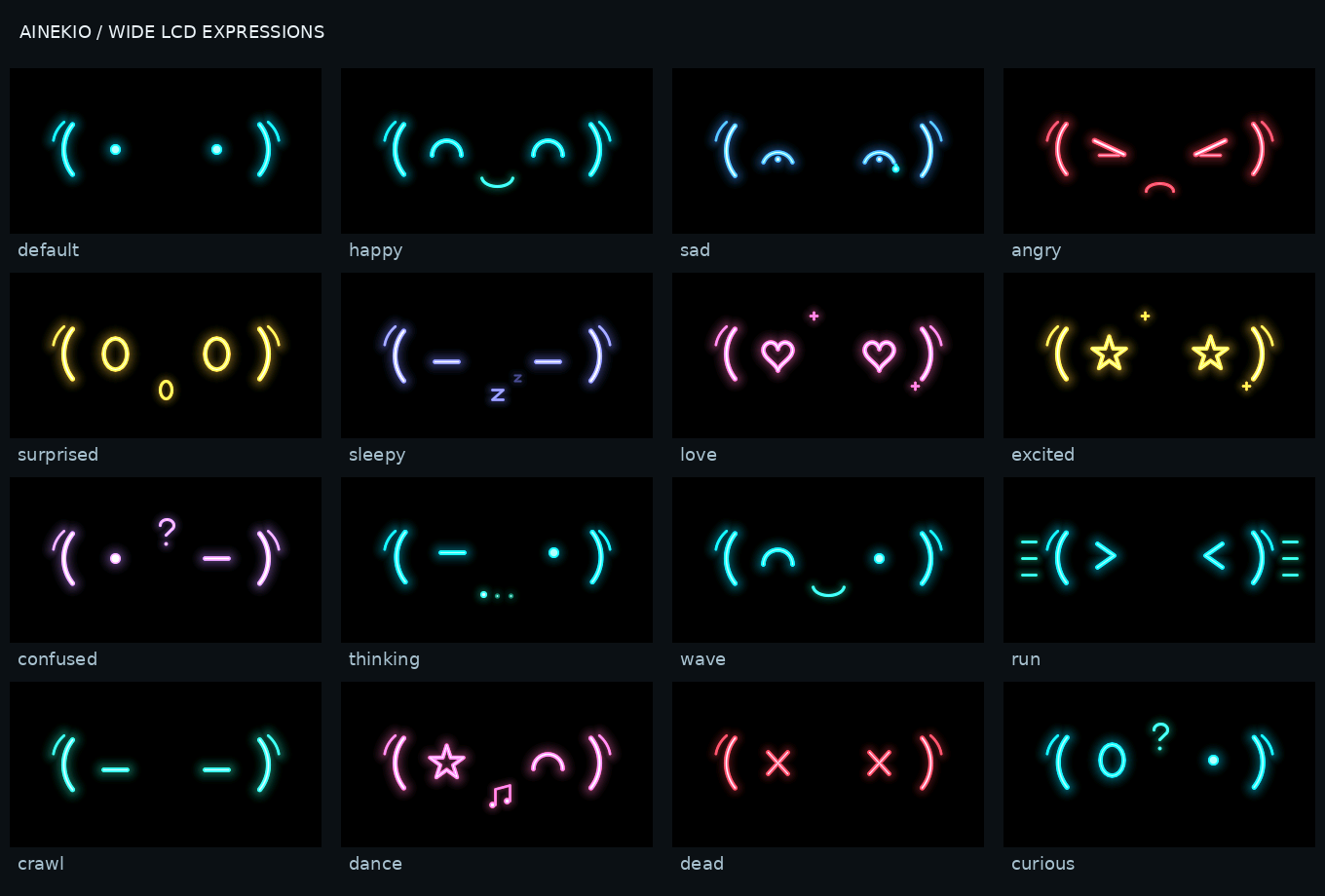
A face on the robot: display, camera and voice
The physical display is illuminated, and the local expression library keeps growing. Explore actual animated renderer previews alongside the recorded camera, speaker and wake-capture results, with newer local refinements clearly identified.
P4 display and media
Wide LCD · 59 face names · renderer previews · dated device checks
Firmware & connections · V2 · 12 servos
Responsive commands and connection choices
Request routing and connection changes, plus speech and person-detection work. Model stop/completion failures and physical Active Operator testing remain open.
MetaHuman OS and Body Control
Task / conversation split · background interpretation · saved connections

Legs & gait · V1 + V2
Gait journal: the robot can stand and walk
The latest entry records standing, walking and command response while preserving the failed standing attempt and all earlier linkage experiments. Exact installed revisions and measured gait performance remain to document.
Continuing technical journal
October 6 / October 8 comparison · physical prototype photograph
Chassis, shell & power · V2 · 12 servos
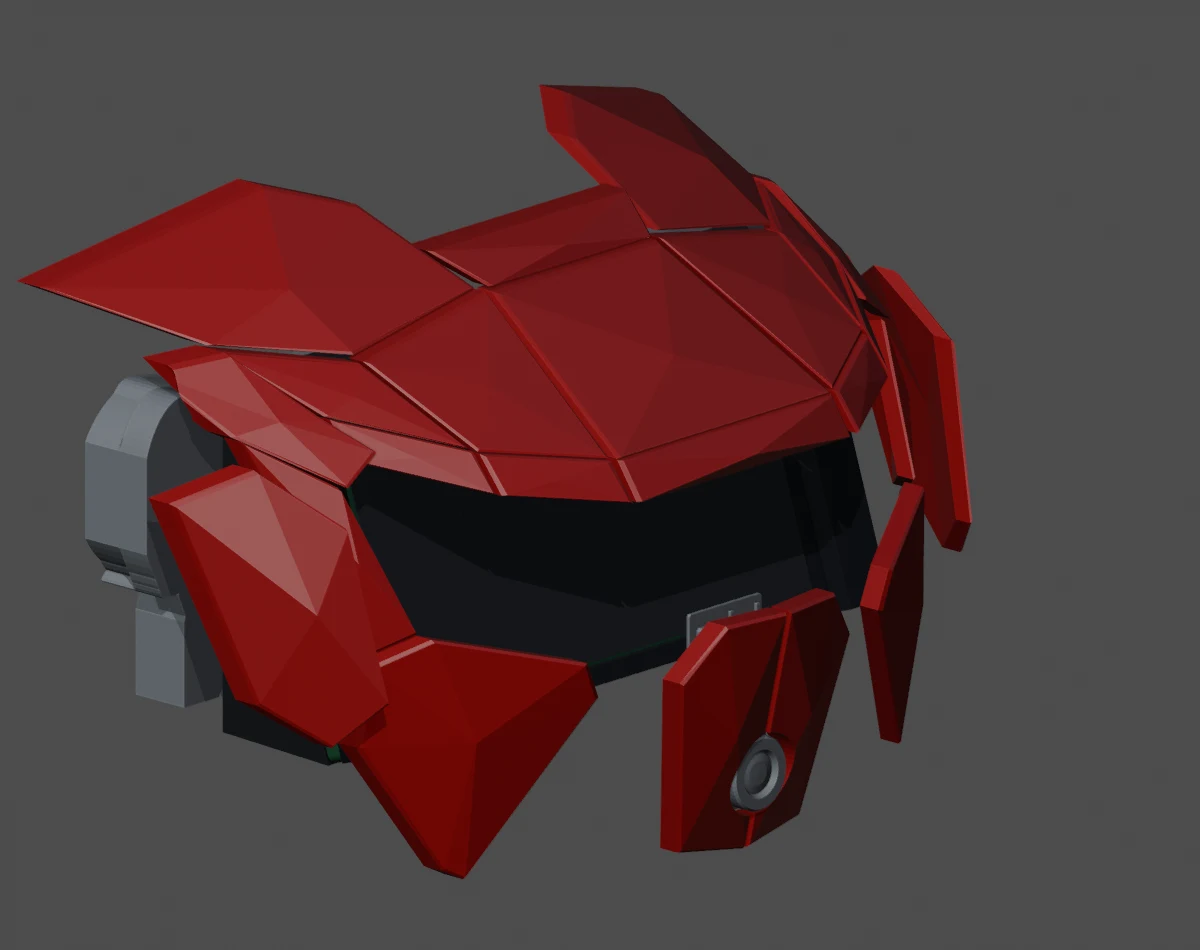
A lighter rebuild after the standing test
The printed chassis could not stand on its MG90 servos. Follow the material removal, move to separate batteries and onboard charging boards, and assembly changes while replacement parts are printing. The revised assembly remains untested.
Printed chassis, Blender revisions and power
Keep MG90 · remove weight · replace the battery bank
Legs & gait · V2 · 12 servos
Shorter carriers and the complete motion library
Compare the shared model and compact candidate, see which foot placements changed, and follow all 23 remapped motions in Blender. Reduced Upright reach and the provisional servo-travel mismatch remain explicit.
Linkage geometry and motion experiments
35 mm carrier · 20 mm crank · 28 mm pickup · 23 motions
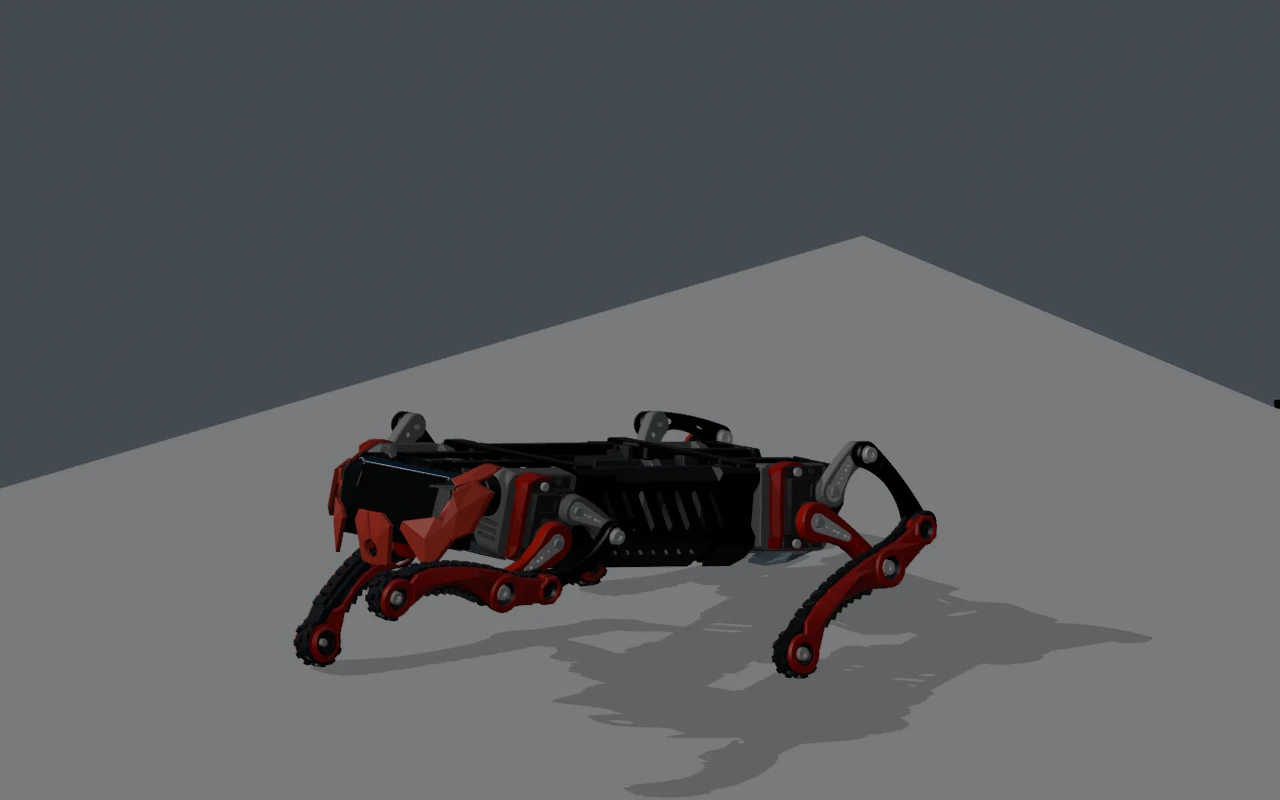
Firmware & connections · V2 · 12 servos
Steering, sensing and keeping the robot connected
The software now includes steering updates, an IMU estimator and expanded camera/recognition interfaces. Desktop ROS checks and a real hotspot connection are recorded separately from live balance control and sustained wireless reliability still to establish.
P4 motion, gateway and ROS 2
Continuous steering · IMU estimator · camera profiles · wireless tests
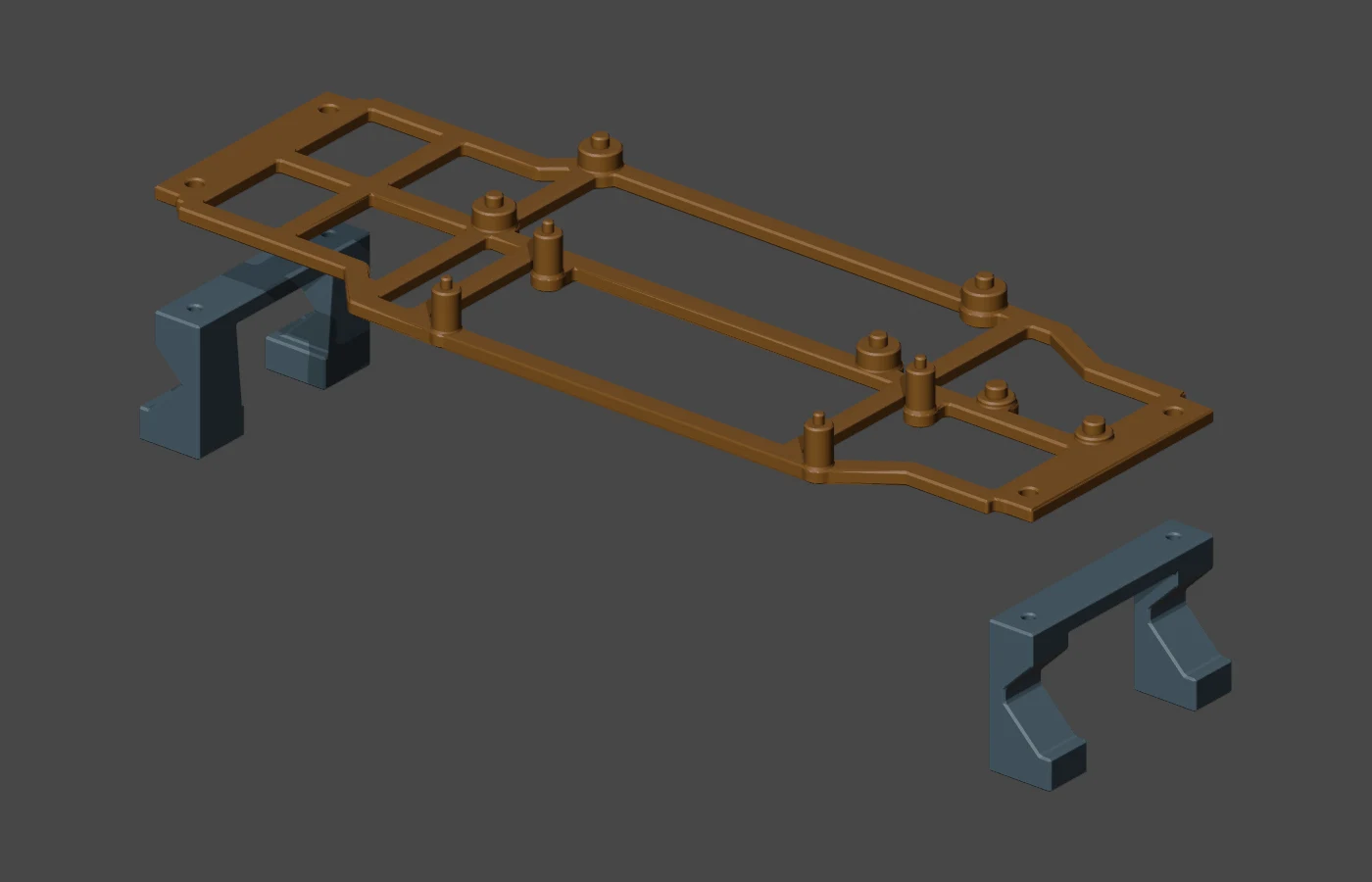
Legs & gait · V1 + V2
Gait journal: physical results and the compact candidate
The newest journal entry connects the failed standing attempt to the revised linkage, records the complete offline library and separates modeled motion from the next physical test.
Continuing technical journal
Standing result · side-by-side dimensions · retained earlier experiments
Chassis, shell & power · V2 · 12 servos
Q6A, chassis work, and a more active loop
Revised v2 geometry, Q6A integration, fresh-frame processing, and saved MetaHuman executions. YOLO and the connected active loop are still being worked out.
Body + MetaHuman OS
6437b24 · c3f56d4
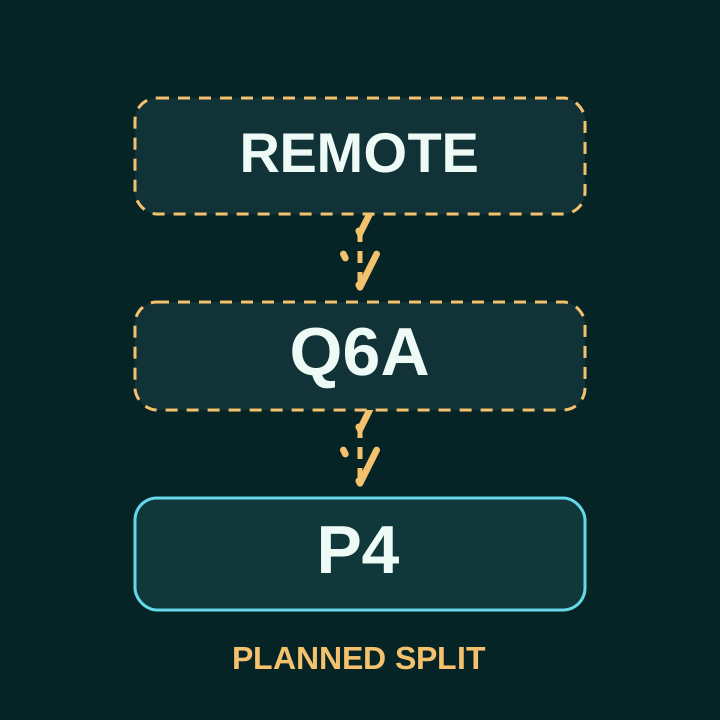
Firmware & connections · V2 · 12 servos
Two builds: Wired, Wireless and ROS 2 integration
The project now has two build directions: onboard Q6A with a planned USB body link, or offboard Q6A over Wi-Fi. Compare their packaging and power budgets, the installed ROS 2 environment, and the remaining work toward responsive gait.
Build options, software and power
Onboard / offboard Q6A · ROS telemetry · local IMU feedback
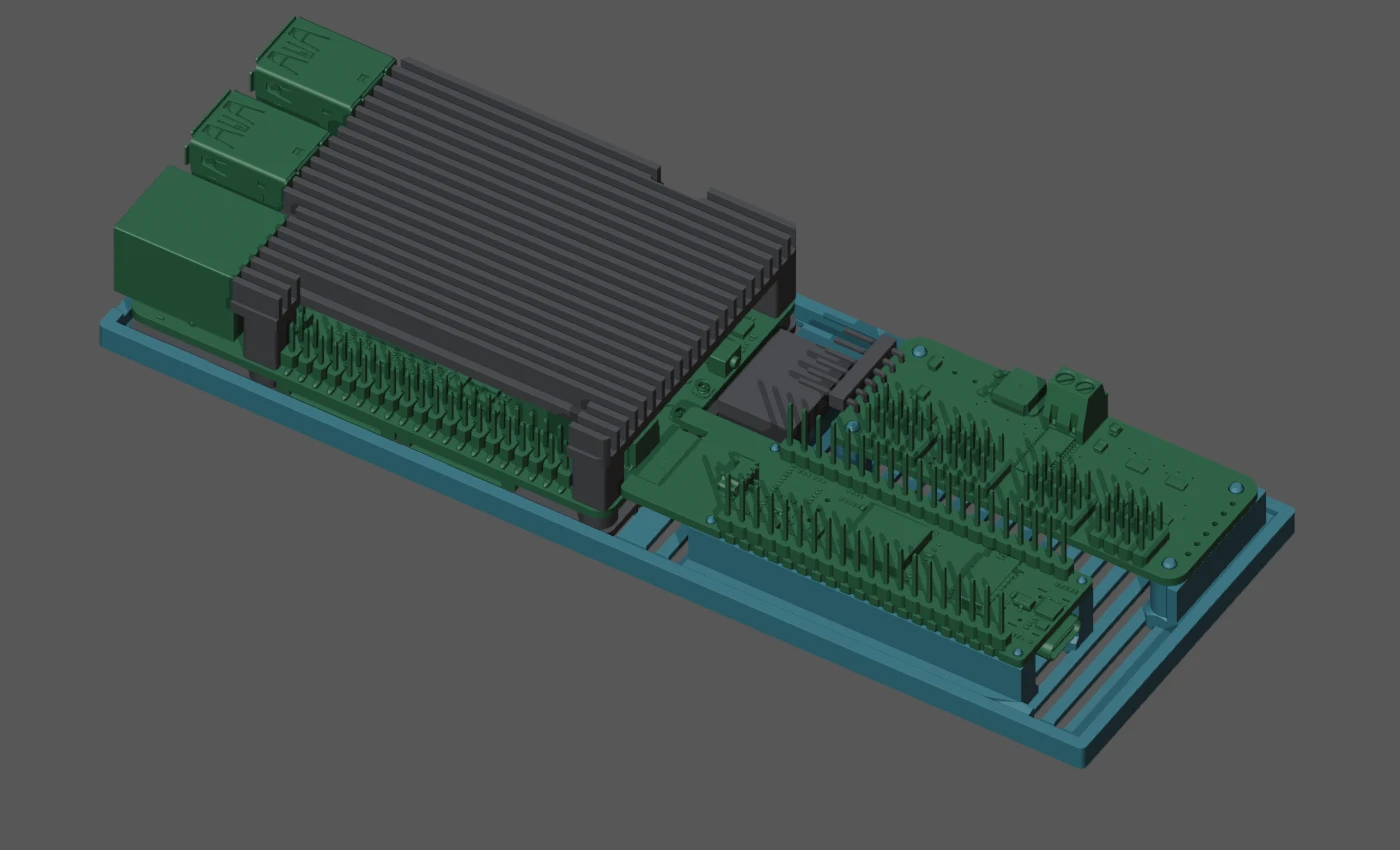
Chassis, shell & power · V2 · 12 servos
Compact Wireless body: battery, face and assembly
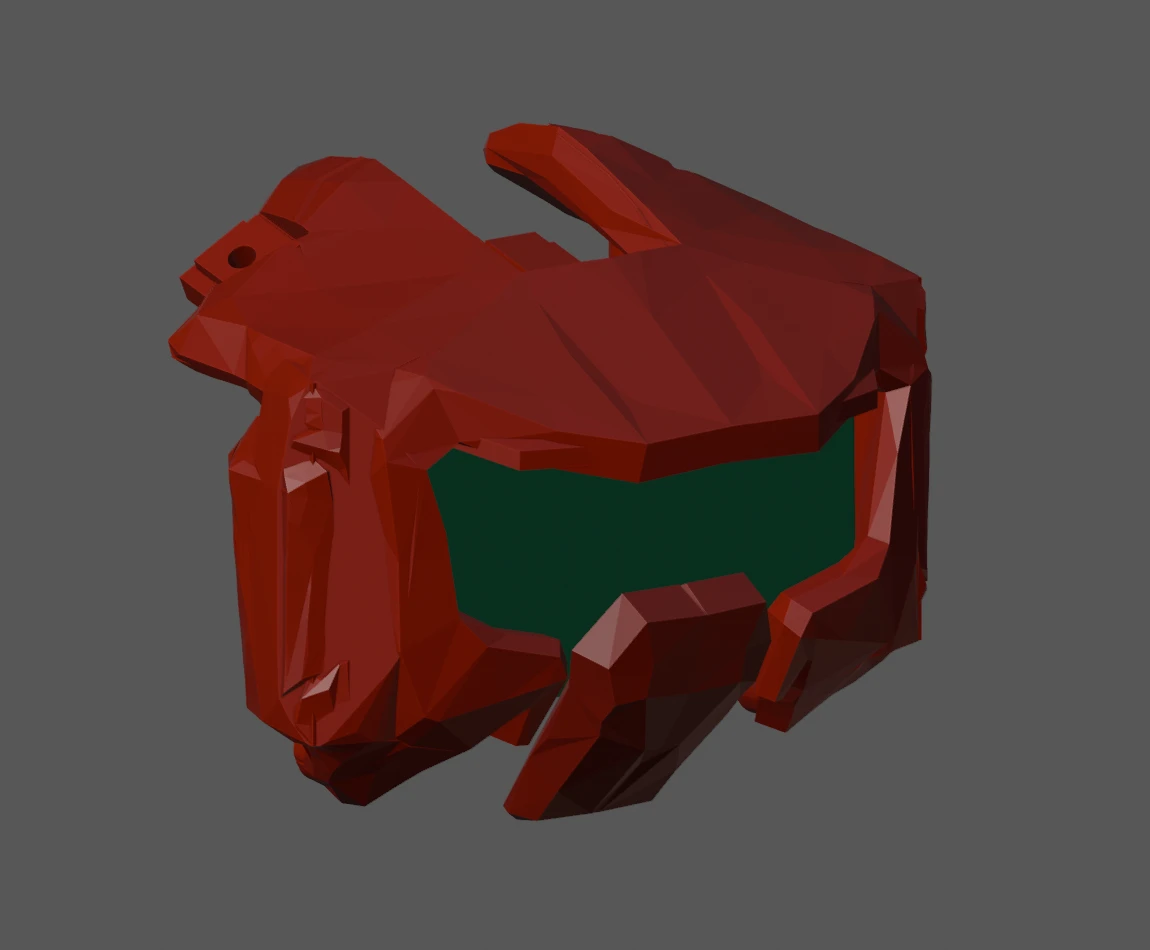
Actual Blender images follow the new build scenes, slimmer tray, LCD carrier and alignment marks. The latest front/rear clearance study keeps the original front carriers and moves those legs forward; body refitting remains in progress.
Chassis and electronics packaging
82.5 mm frame · front-leg relocation · rear carrier relief
Legs & gait · V1 + V2
Gait leverage, saved motion speed and feedback planning
Before/after tables explain the Walk, Run and Crab changes and distinguish continuous gait controls from saved named-motion speed. Offline geometry and settings checks are recorded separately from the local IMU correction loop still to implement.
Continuing gait journal
Revised body references · separate gesture speed · deployment record
Understanding Ainekio · V1 + V2
V1 and V2 comparison: two new build options
The comparison now includes Wired and Wireless V2, the new bank and current control changes, while retaining the explicitly dated September 24 motion-range dataset and unmeasured runtime.
Eight servos versus twelve
Controllers · Q6A placement · SHARGE battery · dated ranges
Chassis, shell & power · V2 · 12 servos
Refining the body and fitting the Anker battery
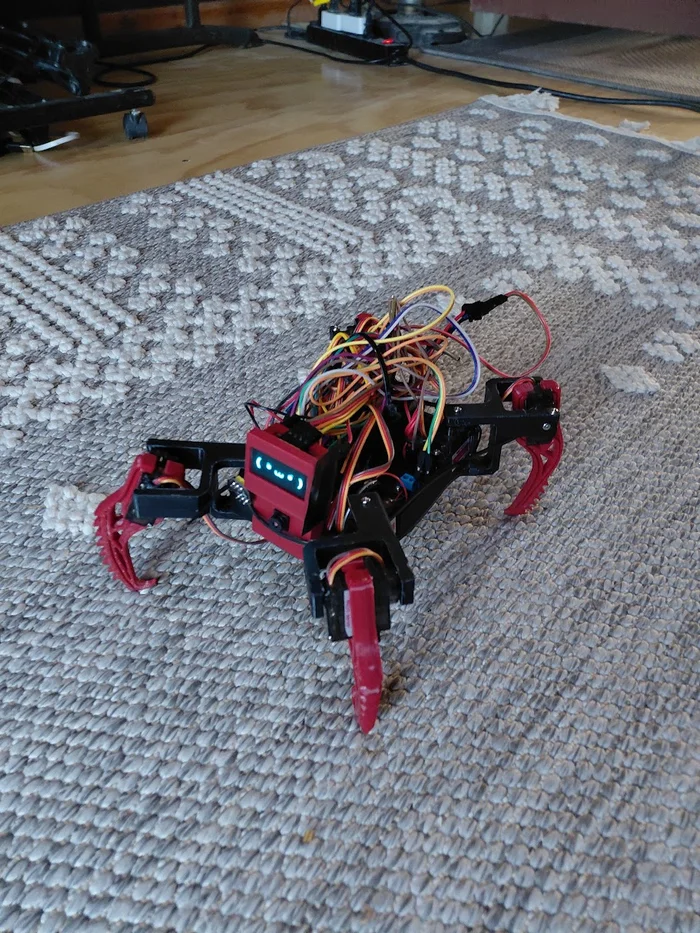
The red body gains compact mask mounts and reinforced tabs while the underside is fitted around the Anker bank already on hand. Follow the width changes, battery clearance studies and remaining assembly work, with actual Blender images.
Chassis, shell and removable power
Revised mounts · 80 mm support placement · 10,000 mAh bank
Understanding Ainekio · V1 + V2
Eight servos versus twelve: the current comparison
Compare the physical V1 and evolving V2, with fresh per-joint range data, ESP32-S3/P4 configuration, the two power arrangements and an explicit record that neither runtime has been measured.
V1 and V2 side by side
Motion ranges · controls · processing · batteries
Legs & gait · V1 + V2
Continuous gaits, reviewed expressions and P4 deployment
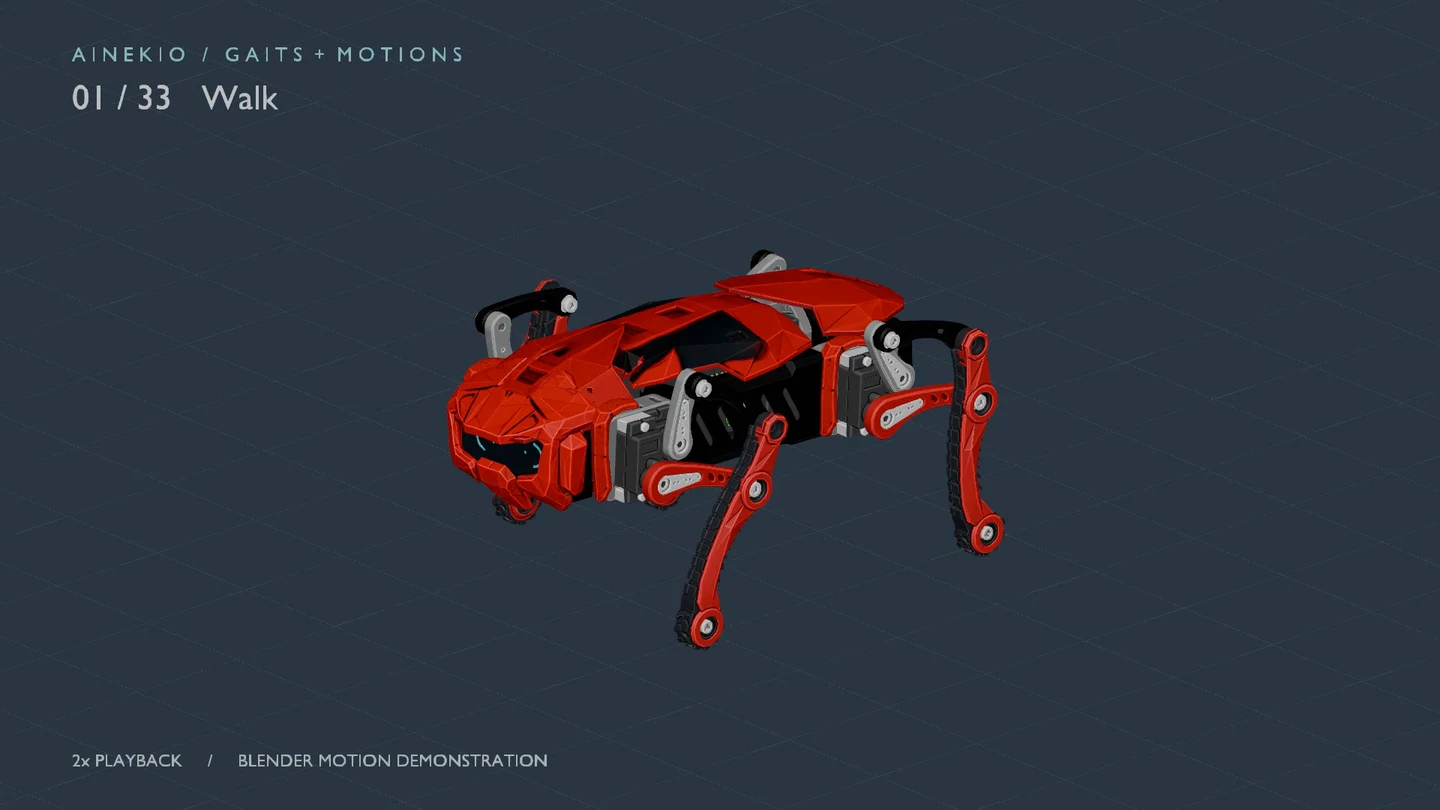
A playable Blender showcase accompanies the new Speed, stride, cadence and Finish controls. The latest entry records revised expressions, six-direction Crab and the September 24 application flash, with the physical tests still ahead.
Continuing gait journal
Walk / Run / Crawl / Crab · 23 finite gestures and postures
Legs & gait · V1 + V2
Integrating variable gait: stride and motion rate
The walking sequence lengthens its steps, doubles its cadence, then returns to short steps. Revised linkage, stance planning, and motion data.
Gait development and integration
14-second Blender demo · independent stride and rate controls
Chassis, shell & power · V2 · 12 servos
Developing the shell around the mechanism
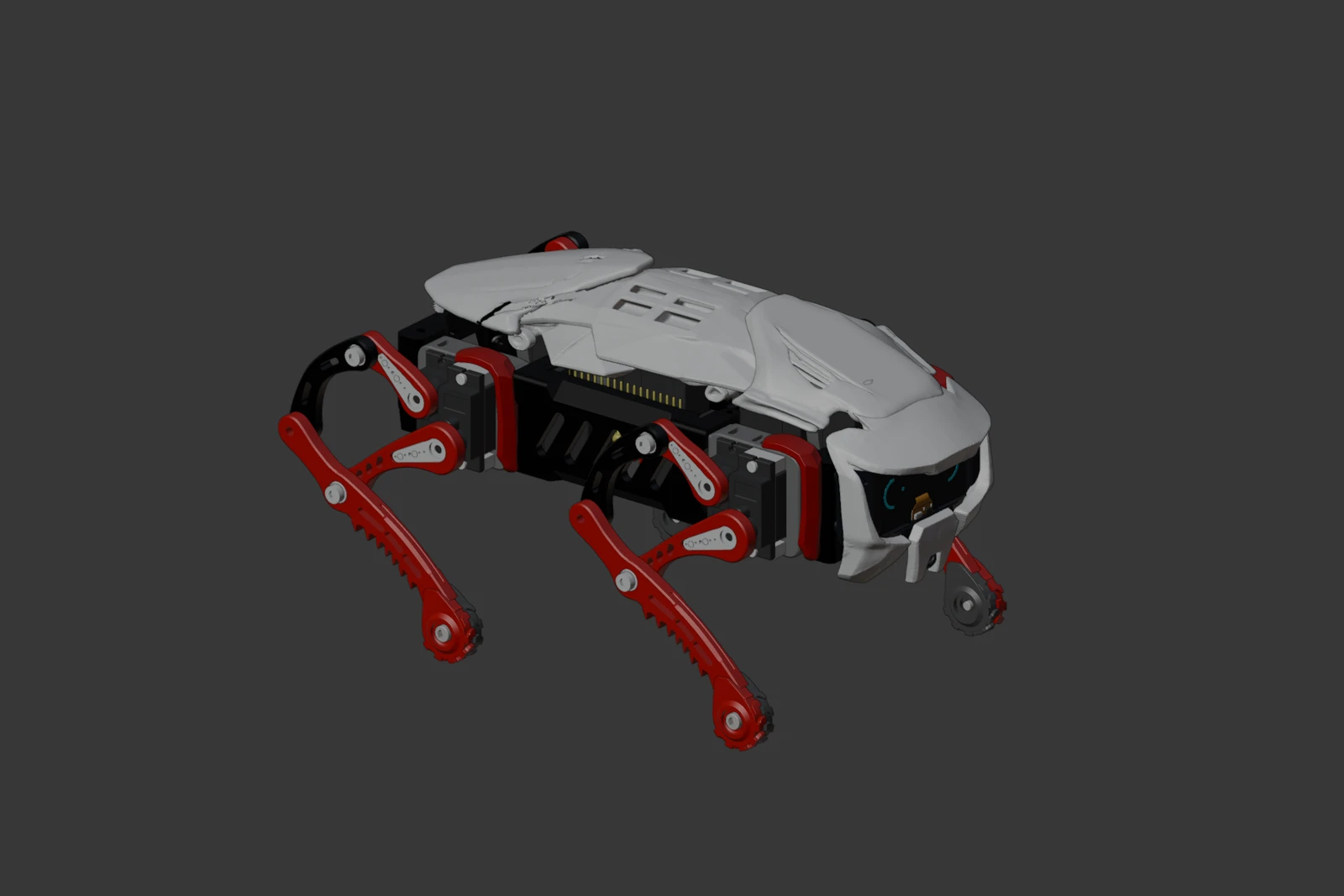
Actual assembly views follow the face, collar, roof and fin work, including rejected trials and a matched roof before/after comparison.
Body and shell design
September 19 iterations · September 20 Blender views
Legs & gait · V2 · 12 servos
Compact legs: geometry, print faces and horn fit
Earlier and compact legs compared side by side, with the horn-cavity correction and upright print files.
Leg mechanism and 3D printing
22/36/55 mm compact geometry · recorded STL exports
Chassis, shell & power · V2 · 12 servos
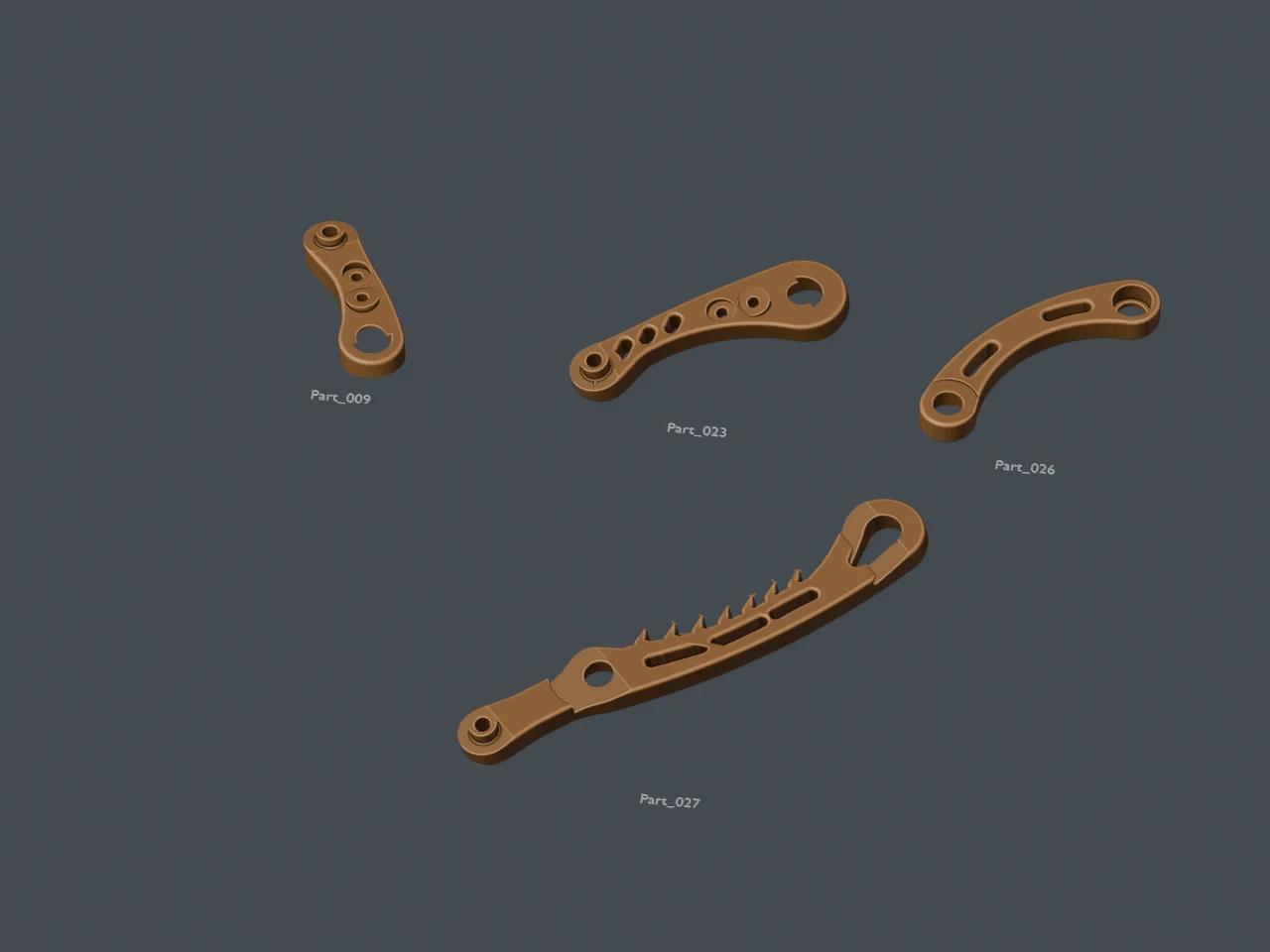
Narrowing the chassis and making room for the face
The narrow-body revision moves the side assemblies inward and revisits electronics packaging. A later front-panel change moves the camera-cable recess below the face.
Chassis and electronics packaging
103 to 51.2 mm · board and cable clearance
Legs & gait · V1 + V2
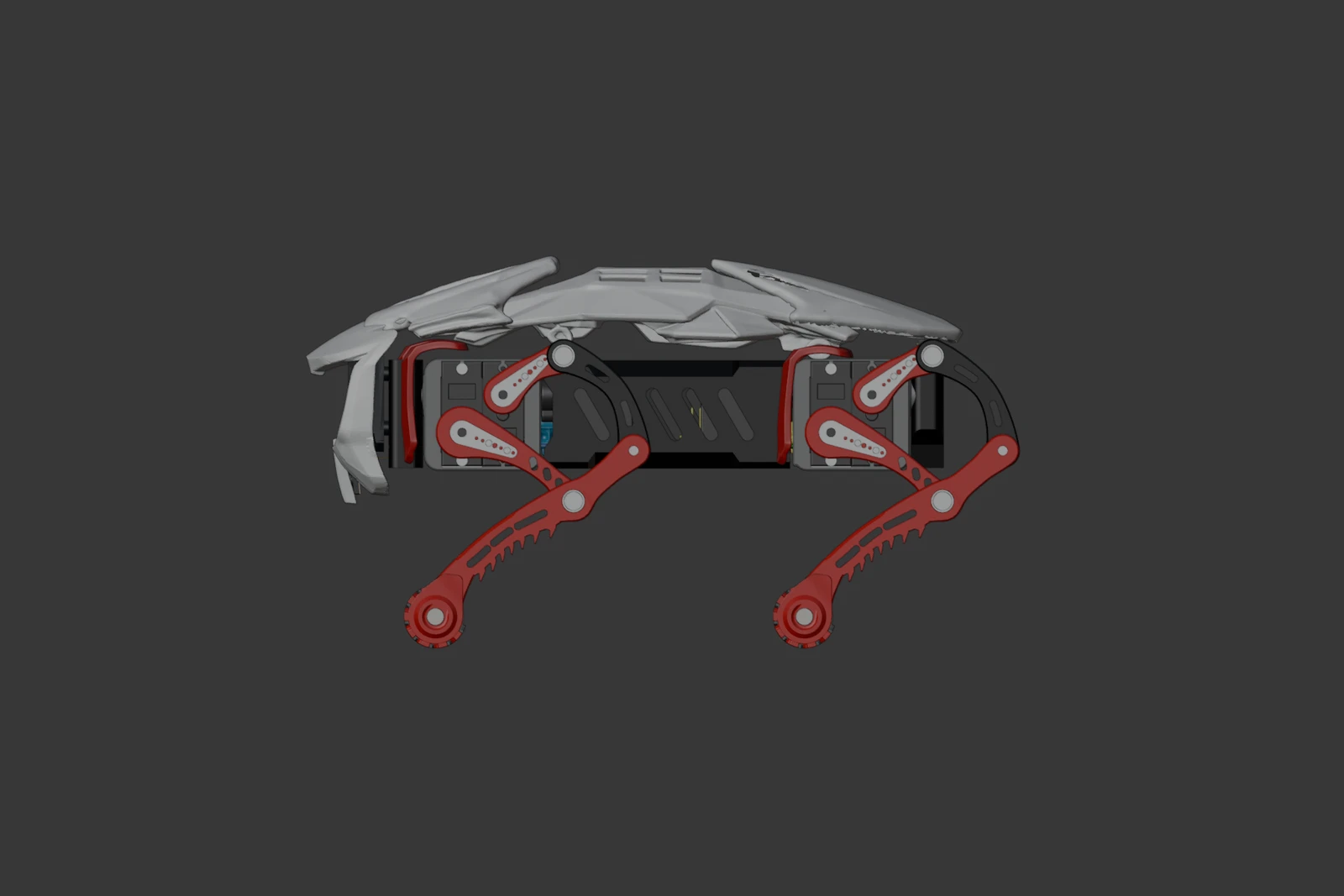
Gait journal: motion studies and compact-leg probes
Dated entries add the motion library and 10/20/30 mm compact-leg probes, with comparison tables, contact assumptions and downloadable results.
Continuing gait experiments
September 17 motion integration · September 19 single-leg study
Legs & gait · V1 + V2
Starting the gait development journal
A continuing technical journal compares the original robot's stored motion ranges with the new linkage's theoretical travel. The first entry includes the mechanism diagram, nonlinear input/output examples, and downloadable range data. Gait calculations are still ahead.
Linkage math and gait development
Eight-servo motion baseline · twelve-servo geometry
Legs & gait · V2 · 12 servos
From Blender to printed leg prototypes
The printed legs have much more expressive movement than the models I have seen online. Three prototype photos, fit problems, revised dimensions, and foot options.
Leg assembly and 3D printing
Prototype photos · September 12–14 design records
Chassis, shell & power · V2 · 12 servos
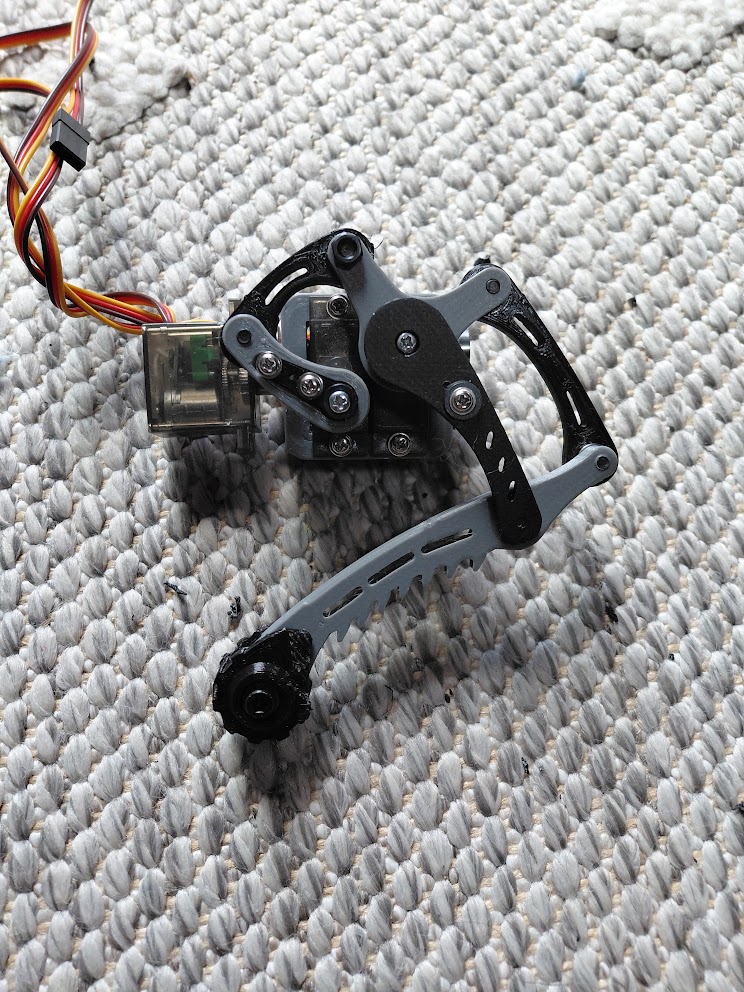
Fitting the V2 body together
The four-leg Blender assembly now includes a wider chassis, electronics, smoother linkages, revised covers, and a camera/display carrier. Fourteen saved revisions, component dimensions, remaining fit checks, and a MetaHuman OS update.
Hardware + MetaHuman OS
Daily design update · actual Blender renders
Legs & gait · V2 · 12 servos
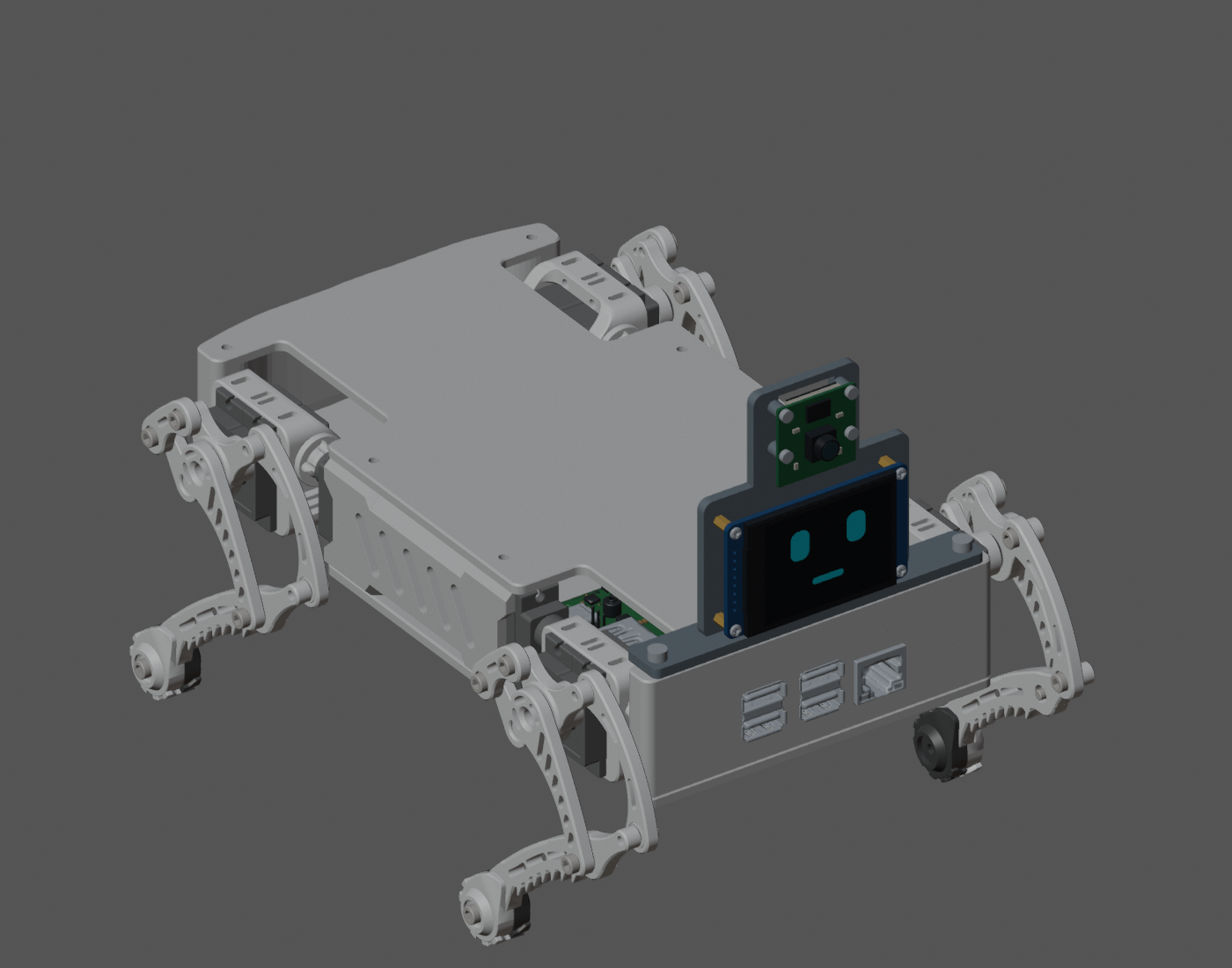
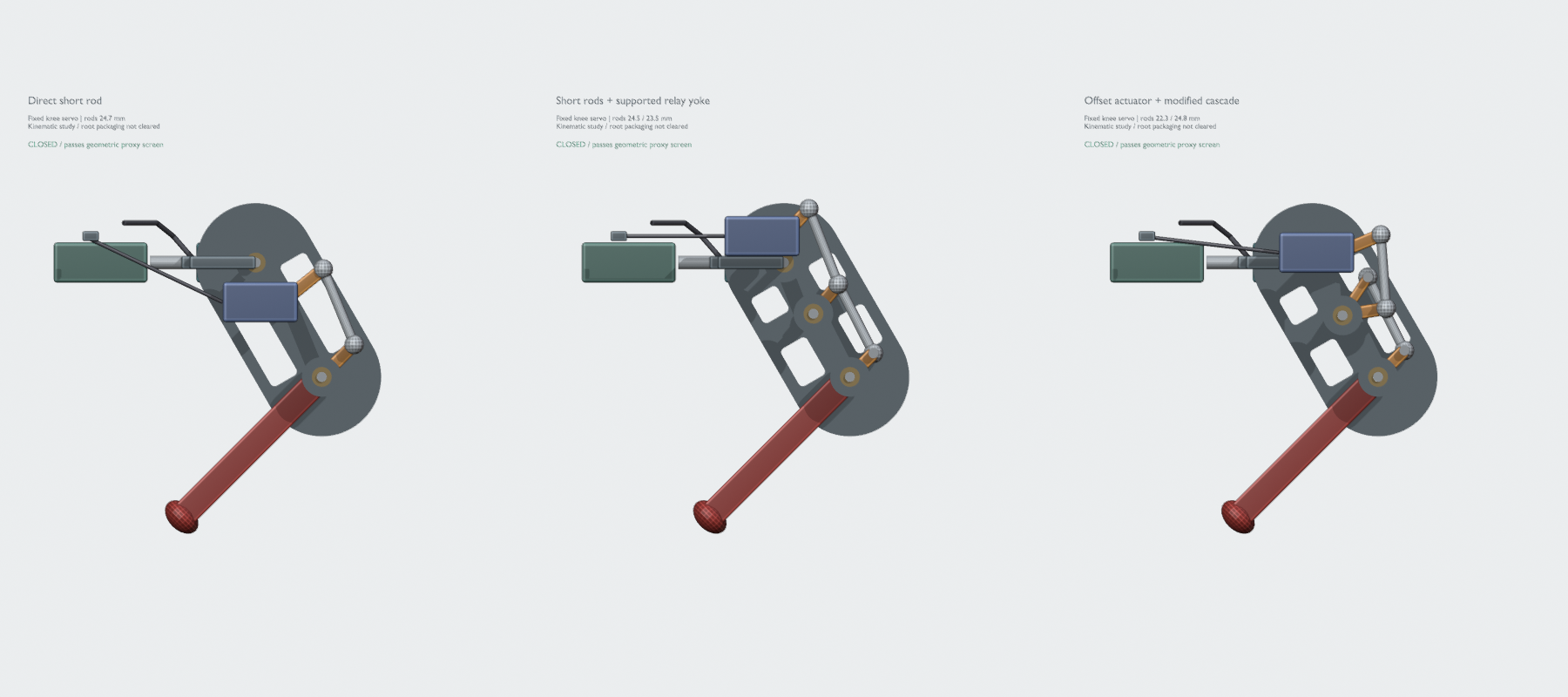
Three ways to drive a knee with short rods
A direct rod, a supported relay yoke, and an offset cascade were compared. The relay remains the next research candidate; none met the complete range and pose brief.
Leg mechanism research
Three Blender variants · modeled motion and collision checks
MetaHuman OS · V1 + V2
Giving robot tasks a clear finish line
Robot tasks now follow a finite plan with a clear completion condition. Pending ideas remain visible without becoming standing movement instructions. Deployment verification remains.
MetaHuman OS
Source repair · controlled workflow tests
Firmware & connections · V1 + V2
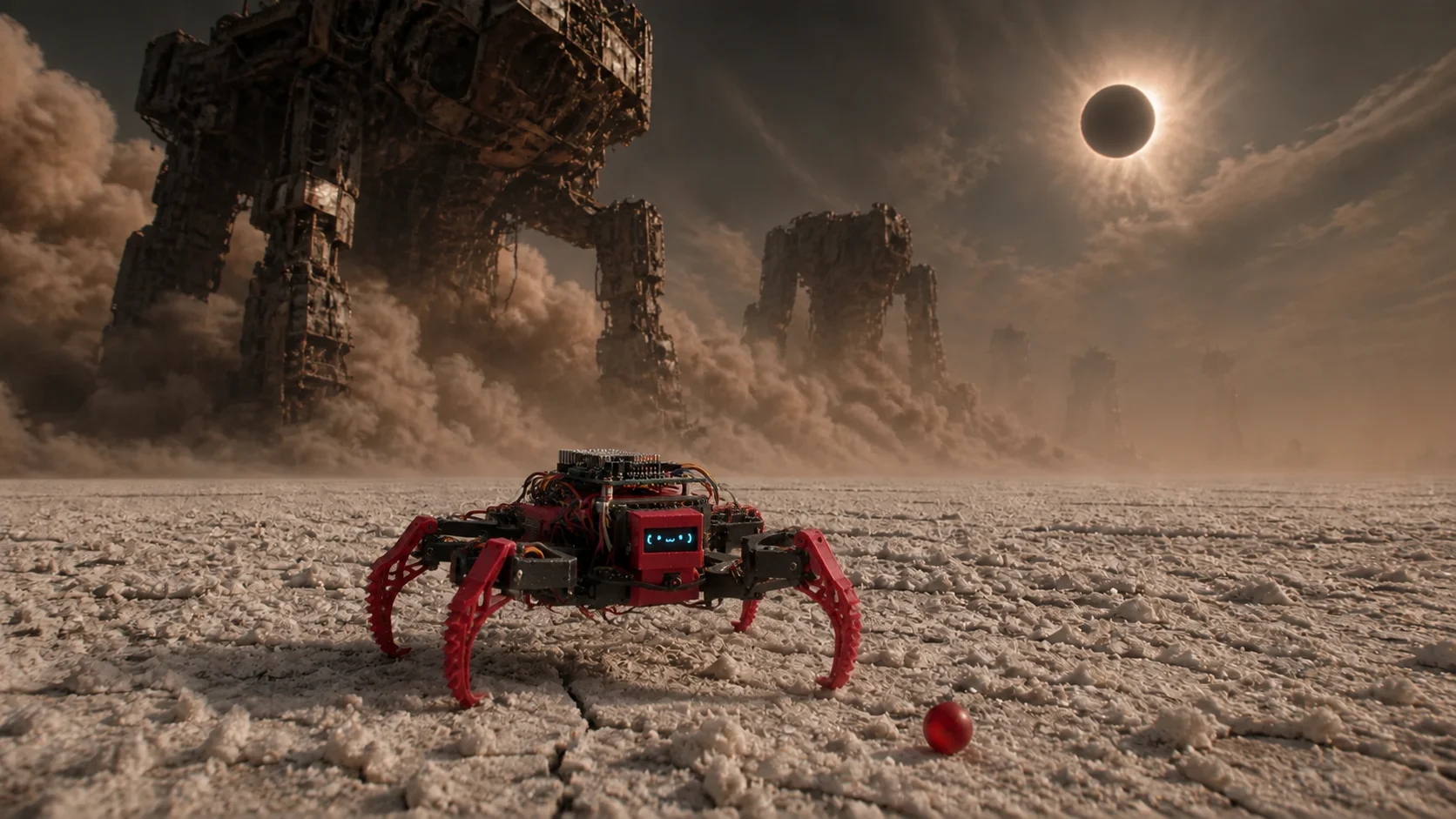
Keeping delayed robot feedback connected
Delayed feedback stays attached to the original command. Recovery tracks the result without repeating movement. Controlled tests passed; a gateway restart and live testing remain.
Ainekio gateway and adapter
68 recorded software checks

Understanding Ainekio · V1 + V2
Live workflow evidence and goal-context repairs
A live review found command feedback, images reaching model requests, and acknowledged speech deliveries. It also exposed stale goals. Later repairs retain truthful execution status and connect specialist answers to the waiting request; physical validation of those repairs remains.
MetaHuman OS
Recorded live run and later source repairs
MetaHuman OS · V1 + V2
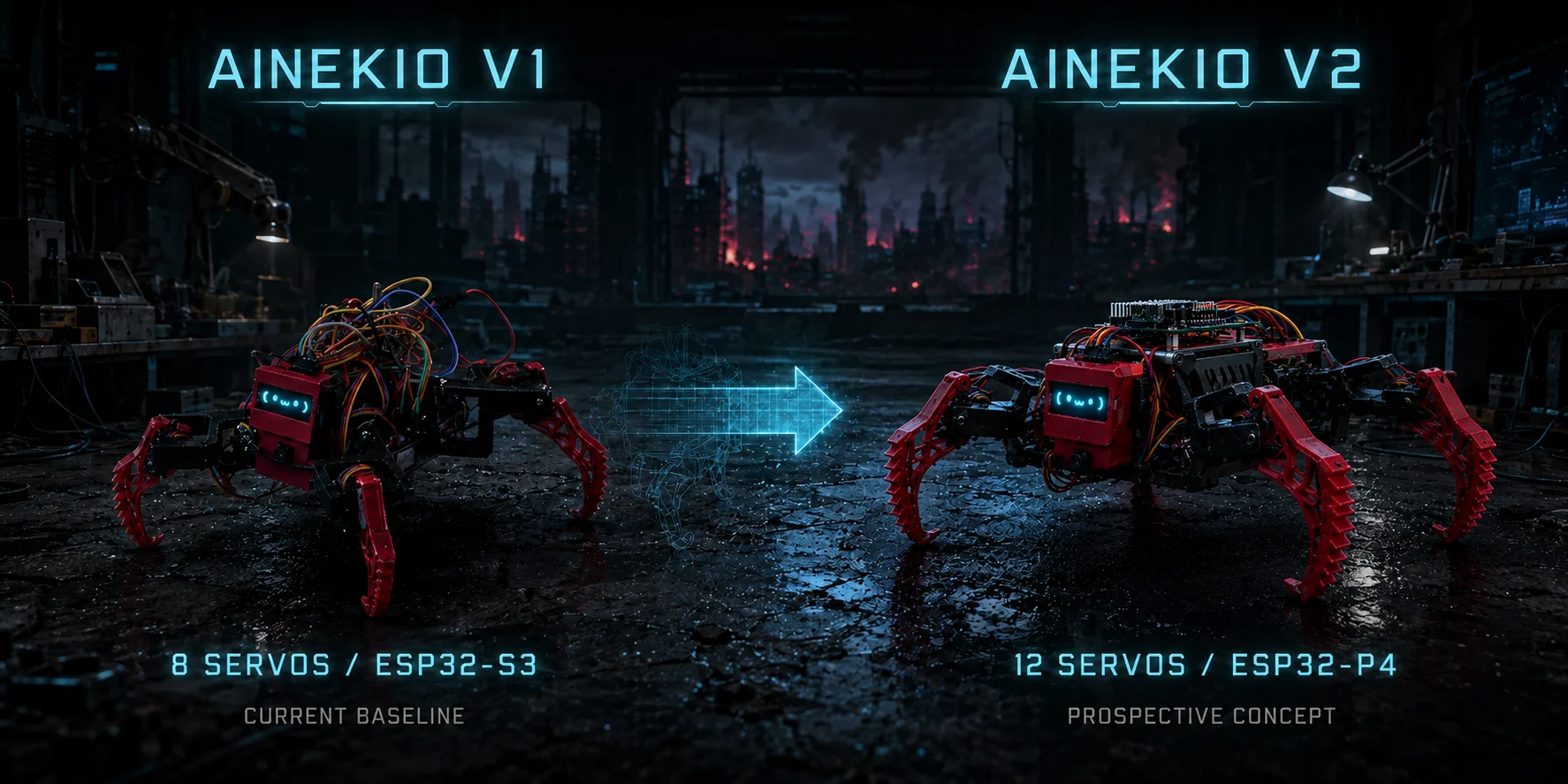
Keeping a request through waits and restarts
MetaHuman’s development code saves what the robot was asked to do, what has finished, and what it is waiting for. This helps a request continue after an interruption. Focused software tests have passed; deployed robot tests remain.
MetaHuman OS and Ainekio gateway
Local integration work
Chassis, shell & power · V2 · 12 servos
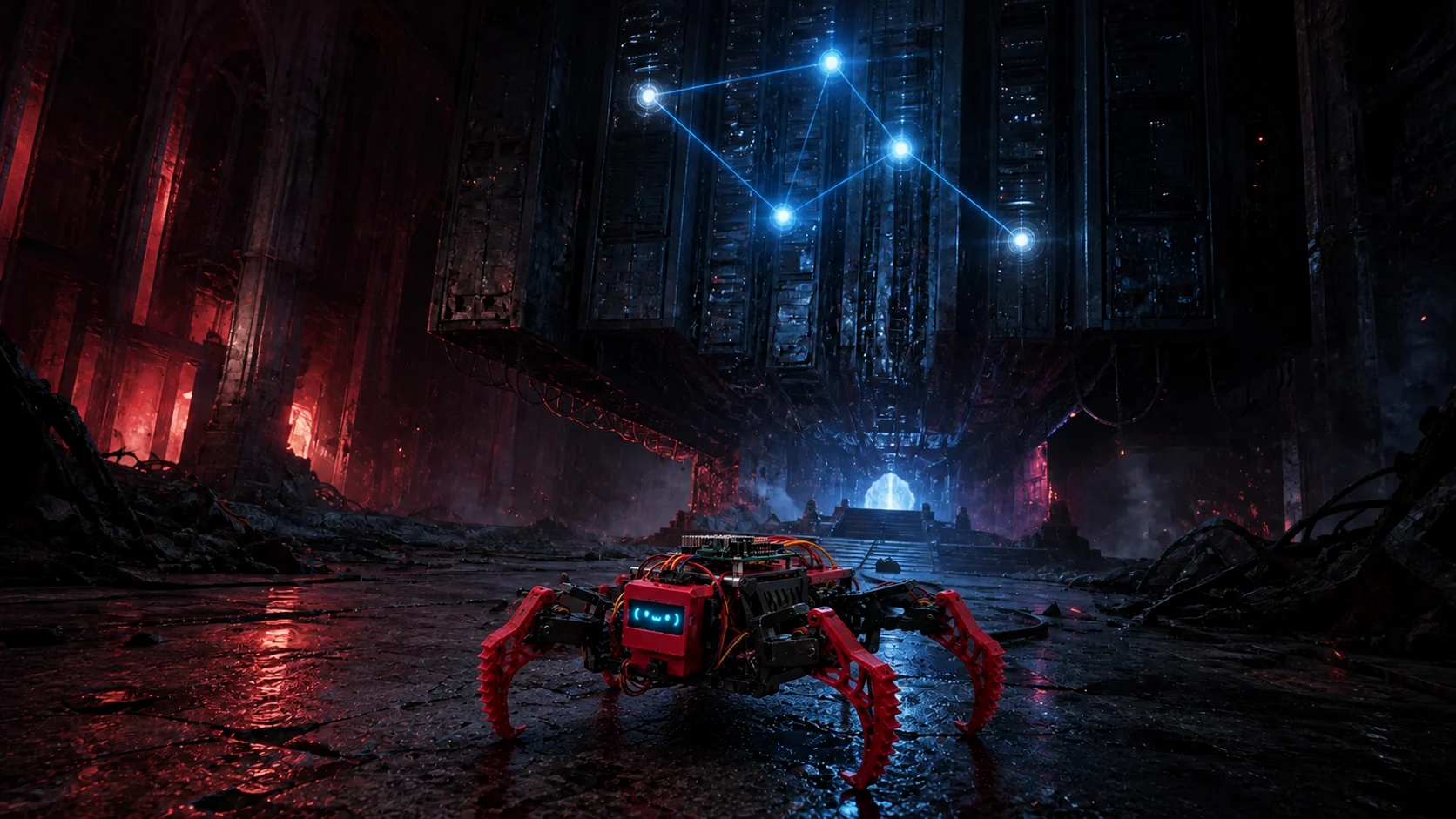
V2 plan: twelve servos and ESP32-P4
V2 adds a sideways hip joint to each leg. An OpenHarmony Puppy V2 reference leg will be tested before the chassis and power supply are sized. Prepared movement sequences come first; adaptive balance is deferred.
Mechanical design
Design note and local leg references
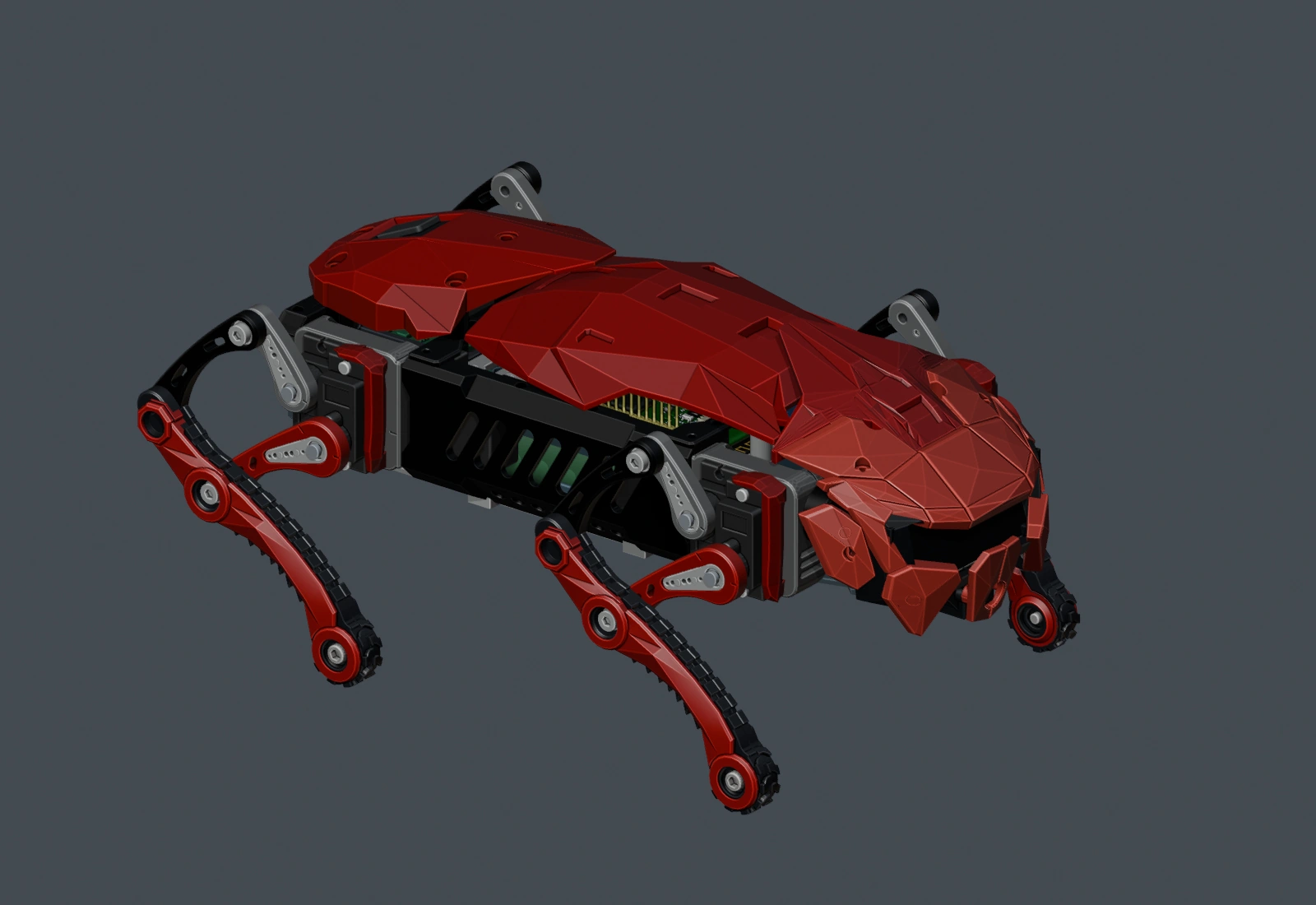
Original eight-servo robot · V1 · 8 servos
V1 parts and wiring corrected
The existing robot’s parts list now identifies its Freenove controller, display, and 1000 mAh battery, and corrects wiring assignments. These V1 details do not determine the planned V2 wiring or power supply.
Hardware documentation
Understanding Ainekio · V1 + V2
Local field guide published
A local guide replaced five remote-document pages and earlier fantasy artwork. It covered hardware, firmware, commands, gateway, camera, speech, MetaHuman integration, and autonomy.
Documentation
10-article field guide
MetaHuman OS · V1 + V2
Robot autonomy responsibilities consolidated
Robot Operator became responsible for when the robot could start an activity. Other software selected actions, carried commands, saved progress, and scheduled jobs. September’s redesign later changed how ongoing requests resume.
MetaHuman OS
5191d6fc
Vision, face & voice · V1 + V2
Wake-word pilot limited after false triggers
The pilot sometimes treated ordinary room sounds as the wake phrase. Its detection threshold and test recordings needed more work; an accepted production wake model is still outstanding.
Voice
Original eight-servo robot · V1 · 8 servos
Camera profile and motion commands updated
Firmware gained the corrected OV3660 capture profile and more named motions. The simulator was also updated at the time; that project is now retired.
Robot firmware
6ad9051
Firmware & connections · V1 · 8 servos
Five-second walk assets installed
Prepared walk sequences were shortened to roughly five seconds and installed in the robot’s LittleFS asset storage. Reading them back and comparing digests checked the installed bytes; it did not measure gait quality.
Motion assets
Vision, face & voice · V1 + V2
Physical audio playback tested
Pacing audio delivery produced clean audible speech in one test. Logs still showed the speaker queue running empty and faults sending microphone audio, so repeated conversation needed further work.
Robot audio
Earlier work
Field updates
Ainekio is a four-legged robot connected to MetaHuman OS for conversation and decisions. These entries follow its hardware and software development. Each entry describes its own date; linked articles explain the components, current limitations, and next tests.
For an introduction to personality, memory, autonomy and learning, read Ainekio as a companion.
See current project status for the latest summary, or browse the full article archive for guides and earlier reports.
Latest: companion systems, locomotion goals, motion and leveling, and 9B learning diagnostics.
October 14: body events, startup and leveling, recording and Wi-Fi updates, and Task model qualification.
October 12: shell, power and motion, YOLOE tracking and trained specialists.
October 8: standing and walking, face and media, responsive commands and connections, the V1/V2 comparison and gait journal.
The October 6 lighter rebuild, compact linkage and steering/sensing entries retain that earlier observation period.
Earlier September 30 Q6A and active-loop work, September 28 Wired / Wireless and ROS 2, compact body and face, Anker fit studies, shell development, compact legs and print files and printed-leg photographs remain available as dated build records.