V1 + V2Dated experiment
A more connected companion: agency, memory and one voice
How Active Operator, model categories, attributed memory and Desire review connect to task execution, with Persona now responsible for the spoken reply.
Published 6 min read
Connecting the companion’s decisions
The latest MetaHuman work connects Ainekio’s conversation, intentions and physical results more closely. It clarifies who chooses an action, who speaks, which experiences inform a desire, and what happens when a workflow receives new information or its template is edited.
These are substantial improvements to the foundation. Recorded deployments and live component checks support the changes below; reliable everyday companionship, accurate goal assessment and sustained autonomous activity remain unfinished.
Agents, workflows and models do different jobs
An agent initiates or coordinates a function. A node workflow connects its context, model calls, actions and saved results. A model category selects the responsibility of one inference call; the status widget assigns a concrete model or adapter to that category. One model may serve several categories.
The shared category list now appears in both model settings and workflow nodes:
| Category | Responsibility |
|---|---|
| Orchestrator | Interpret requests and events; select routes, tools and context |
| Task Decisions | Select supported actions and task controls |
| Planner | Develop and revise complex plans |
| Persona | Express identity, personality, conversation and self-directed intentions |
| Psychotherapist | Independently assess attributed experience, behavior and outcomes |
| Vision | Interpret images and support visually grounded planning |
| Curator | Review and prepare attributed memory and training records |
| Coder | Work on code and technical solutions |
| Summarizer | Condense information while preserving meaning and attribution |
| Embedder | Represent records for retrieval and similarity search |
The former separate Environment Intent setting is consolidated into Orchestrator, preserving its trained small-model assignment. The October 15 activation record confirms the existing 0.8B Intent and Task adapters remained selected. Persona and Planner used the configured 9B service; Psychotherapist used the configured Big Brother provider. These are dated, editable assignments.
Visual work explicitly selects Vision. An incompatible image request no longer silently substitutes the Orchestrator category. Selecting a model category also does not grant an agent permission to change another system’s records.
One owner for the spoken reply
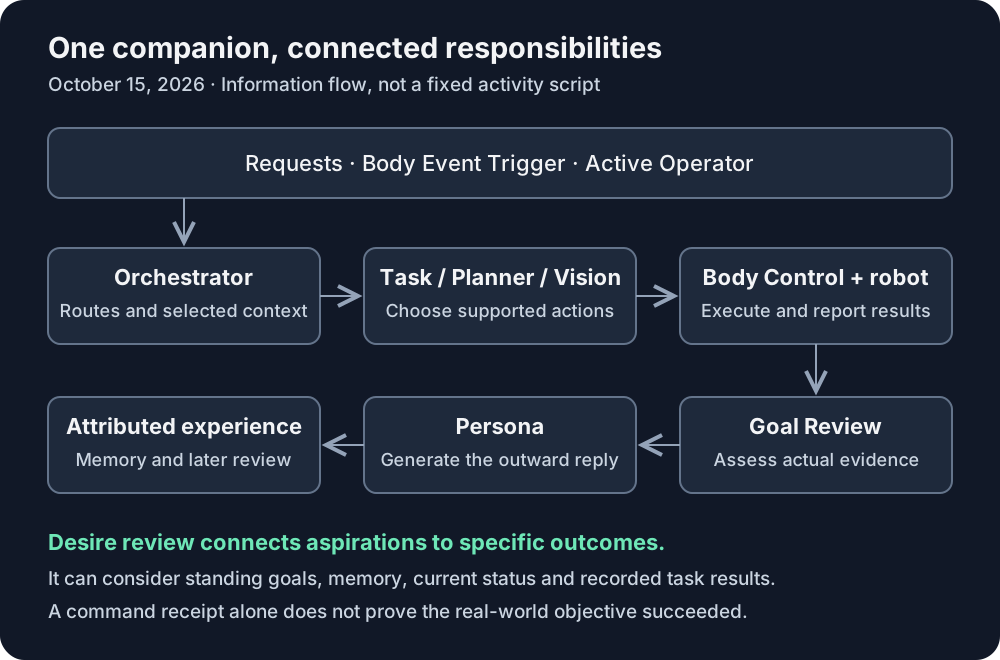
Intent decides whether a response is needed. Task selects executable actions. Goal Review assesses the evidence and whether work should continue. Persona receives the selected results and applicable assessment, then generates the outward reply through the existing conversation delivery path.
Task speech steps have been removed. This supersedes the ordered-speech interface described in the October 14 reports. Task no longer inserts exact spoken lines between movement steps, and Goal Review no longer publishes a competing reply. Persona owns conversation persistence and speech delivery. Independent work can still overlap; this change does not impose a global serial schedule.
The repair has source, workflow, build and served-graph evidence. It removes competing publishers, but does not establish that the model will always say something appropriate or avoid repetition across separate turns. Physical playback was not part of that activation check.
Standing goals and specific desires
Persona goals describe longer-term development and aspirations. A desire is a specific desired outcome managed in Agency. A desire may be reviewed, planned, acted on or retired as the situation changes.
Desire review now receives standing goals, attributed memories and operational evidence: selected-robot status, available capabilities, original requests, selected programs and actual recorded results. What the robot promised, what it selected and what returned from the body remain separate evidence.
This matters when interpretation goes wrong. One recorded request asked the robot to watch a person stretch; the Task model instead selected the robot’s own stretch, with no watching action. The new context exposes that mismatch to Desire review. It does not repair the originating Task decision or force the model to create a desire.
The model can reassess all open desires and choose their strength directly. A zero-strength decision archives the desire and requests cancellation of its associated work through the existing work coordinator. Agency now defaults to All Open, so an intention below its activation threshold remains visible. Proposed relevance decisions reach generation with their uncommitted status identified; unchanged evidence is not relabeled as a new experience.
An October 15 live review archived two old desires and retained their histories. Neither had active work to cancel, so this verifies persisted review and archival, not physical cancellation. A later diagnostic with richer operational context changed one assessment while leaving production records untouched. These are useful checks of context delivery, not broad proof of decision accuracy.
Memory and persona keep their authorship
Desire’s inputs now retain who spoke, when, the source and cognitive mode, execution identity, and the memory’s recorded type. A daydream remains imaginative content; a prior assistant claim remains a claim. Background work also preserves the originating cognitive mode separately from its internal agent execution mode.
The Psychotherapist agent is the sole autonomous editor of persona through the existing review system. Desire no longer promotes reinforced intentions into persona goals. Manual persona editing remains available. Selecting the Psychotherapist model category for a Desire review does not transfer that agent’s authority to write persona.
Dream storage, retrieval and use still need separate qualification. Recent tests found both temporal-routing failures and model confusion about attributed inner activity. Saved memories alone do not establish reliable recall, and the complete Sleep/curation/learning cycle remains unqualified.
Active Operator and workflow continuity
The existing autonomy scheduler now appears as Active Operator in the Agent Catalog, with its mode control and six existing child-workflow links. The implementation was moved into that agent; no second scheduler or new model call was added. Reactive, Semi and Full retain their existing responsibilities. Body Event Trigger remains the separate path for wake, tilt and rapid movement, forwarding its decisions to Environment Mode.
The live catalog confirms the new agent entry. The background worker had not been relaunched in that check, and concurrent source edits prevented a claim of complete build parity for that refactor. A visible catalog entry is not proof of a newly started worker or qualified Full autonomy.
Two execution changes address earlier continuity failures:
- Incoming results remain recorded, while the existing execution store combines pending requests to resume the same workflow. A live mixed-event burst grew from 23 to 41 events without an expanding pending-resume backlog.
- Admitted work retains its original graph; a child retains its graph once entered. New work uses the edited template. Runtime and schema compatibility checks still apply, so a code upgrade can still invalidate older work.
Neither change decides the robot’s behavior. The model can still invent an objective, select an unsuitable action or overstate success from a command receipt. Those failures remain visible rather than being counted as completed companion behavior.
Evidence and next work
This report draws on the October 14–15 Robot Bible and integration records, checked against the shared category catalog, Agency context reader and current workflow source. It summarizes public system behavior without publishing the private conversations or diagnostic packets. The source snapshot manifest identifies the reviewed records.
Next qualification includes grounded action selection, reliable dream recall, end-to-end priority and speech delivery, and successful autonomous outcomes. Locomotion goals, motion controls and the new 9B training diagnostics have their own evidence and limitations.
A more connected companion: agency, memory and one voice
https://ainek.io/posts/2026-10-15-companion-systems/