V2 · 12 servosDated experiment
MetaHuman: keeping an intention through its results
Full Auto can continue existing work and request relevant memory; live trials expose the remaining initiative gap. Queue and on-demand model changes reduce avoidable overhead.
Published 4 min read
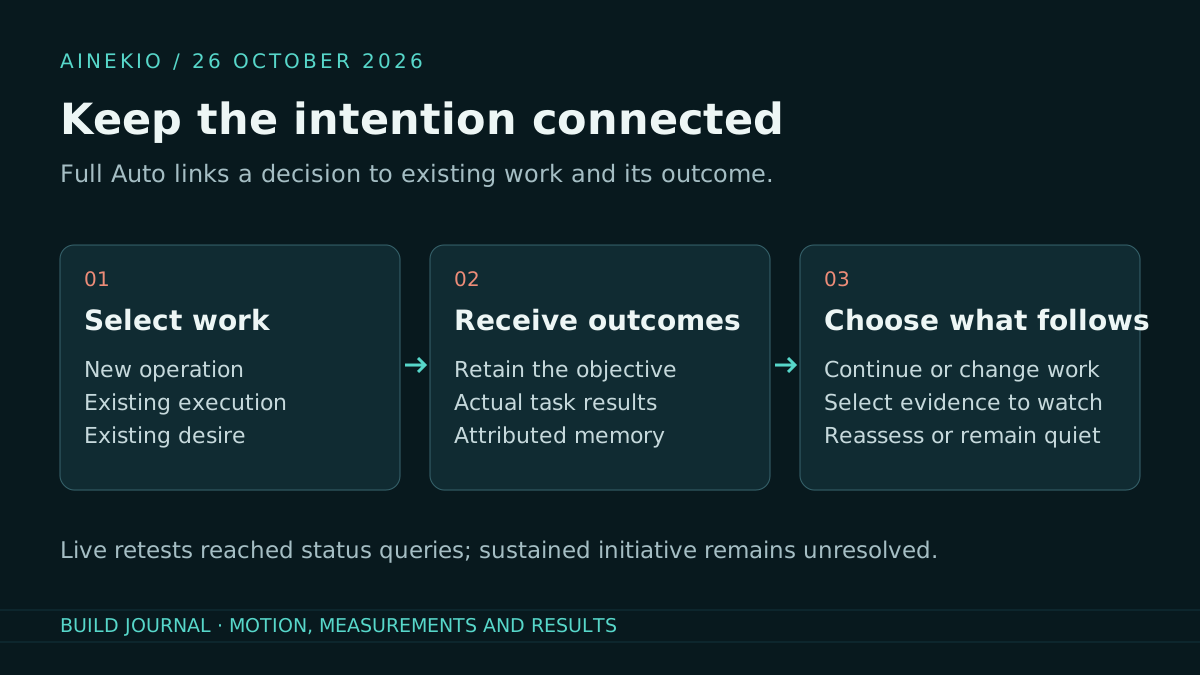
This round concentrates on what happens after a decision: keeping the objective, seeing its result, and choosing whether to continue. The software now connects those steps more directly. The live robot still does not reliably start useful activities on its own.
Continue the existing intention
Full Auto can select a new operation, address an existing execution, or ask the existing Desire system to plan, execute, review or check in. Selected work retains its identity and original objective across those handoffs.
| Decision | Earlier problem | Updated behavior |
|---|---|---|
| Continue work | A new function selection could lose the earlier purpose | Target the recorded execution or desire |
| Use memory | Retrieved context and attribution could be lost in transit | Request relevant memory for the next assessment and retain its source |
| Interpret a result | Queue receipts could stand in for actual progress | Read the retained execution outcome, including incomplete visual goals |
| Think again | Bookkeeping could look like new evidence | Subscribe to selected input, result, environment or desire changes; optionally select a time |
| Stay quiet | A running loop could reassess without a useful reason | A quiet selection stays quiet until reactivation or the selected event |
Speech, sensing and independent requests can continue while an assessment or physical action is in progress. These choices govern when Full Auto reassesses; they do not serialize every robot function.
What the live Full Auto tests actually did
The first connected-body run on October 26 completed 30 assessments and selected no activities. Its context included persona, four standing goals, twelve attributed memories, thirteen available operations and an image.
One misleading input described the last manual command as an active takeover after it had already finished. Robot Status now reports that as the last command source and keeps actual current work separate. Correcting that fact did not, by itself, make the model initiate useful work.
The provider path was also mixing graph requests with coding-session context. The repaired path preserves the graph’s own system instructions, selected messages, image and output contract. Full decisions now use high reasoning; ordinary execution calls use no reasoning.
| Connected-body observation | Result |
|---|---|
| Initial 30 assessments | No activities selected |
| Later 19 assessments | One Robot Status request, its result recognized, then no new pursuit |
| Final seven assessments | One status request after a person appeared; no self-directed conversation or motion |
The queue drained, the result returned to the controller, and the previous Semi mode was restored after testing. The handoff works in those cases; the companion’s initiative remains the problem to solve.
Keep events separate from changing measurements
A body event or offline/online transition could be overwritten by ordinary telemetry before the next assessment. The Bridge now retains the attributed event identity and connection revision separately from the latest sensor snapshot.
The wake logic also separates operating state, body events, scene changes and sensor samples. Uptime and processing counters are not new environmental evidence. Measurement freshness belongs to samples; it should not repeatedly announce a new hardware state. Person detection can still change frequently, and those scene changes can still trigger subscribed assessments.
Snapshot publication now uses an atomic file replacement. The reproduced partial read had briefly presented an empty, disconnected state while a file was being written. The repair preserves the last complete snapshot during publication.
Conversation context is not stuck work
A question that had already been delivered could remain listed as unfinished processing while waiting for a reply. The execution owner now marks that retained context idle, and actual input reactivates it. The conversation and objective are kept; the queue no longer presents an unanswered question as a running job.
The same work removes a detached remote dispatcher that could admit follow-up work after cancellation. Continuations and child speech jobs retain their originating priority. SQLite remains the queue ledger; obsolete JSON migration and duplicate in-flight bookkeeping were removed.
The activated queue check reported no queued jobs or unfinished processing. Focused lifecycle checks passed, while older Goal Continuation fixtures and five existing architecture violations remain in the repository’s test record.
Load model weights when needed
The October 24 llama.cpp change keeps the existing services and lets llama.cpp load weights on demand. Its default idle interval is 300 seconds, after which idle weights can be released. This is separate from the robot’s inactivity-rest timer and Active Operator’s assessment schedule.
The October 25 runtime changes also reduce persistence work between response stages. These changes target model residency and software overhead; there is no new end-to-end spoken-response benchmark in this update.
Next experiments
The useful acceptance test is an entire interaction: notice something, choose an activity, receive its result, and decide what follows. The latest runs reach a status query and stop. I still need useful nonphysical initiative, self-directed conversation and sustained embodied activity, alongside the motion model’s standing and recovery work.
Records
Reviewed: the October 25 autonomy-continuity and queue-lifecycle records, including
the October 26 live retests; bin/llama-cpp-services; and the changed Bridge,
Robot Status and execution owners. These records include local changes beyond
the published repository commits. Source record.
MetaHuman: keeping an intention through its results
https://ainek.io/posts/2026-10-26-metahuman-continuity/